World Ocean Day 2026 | Protecting Our Oceans for a Sustainable Future
06 Jun 2026
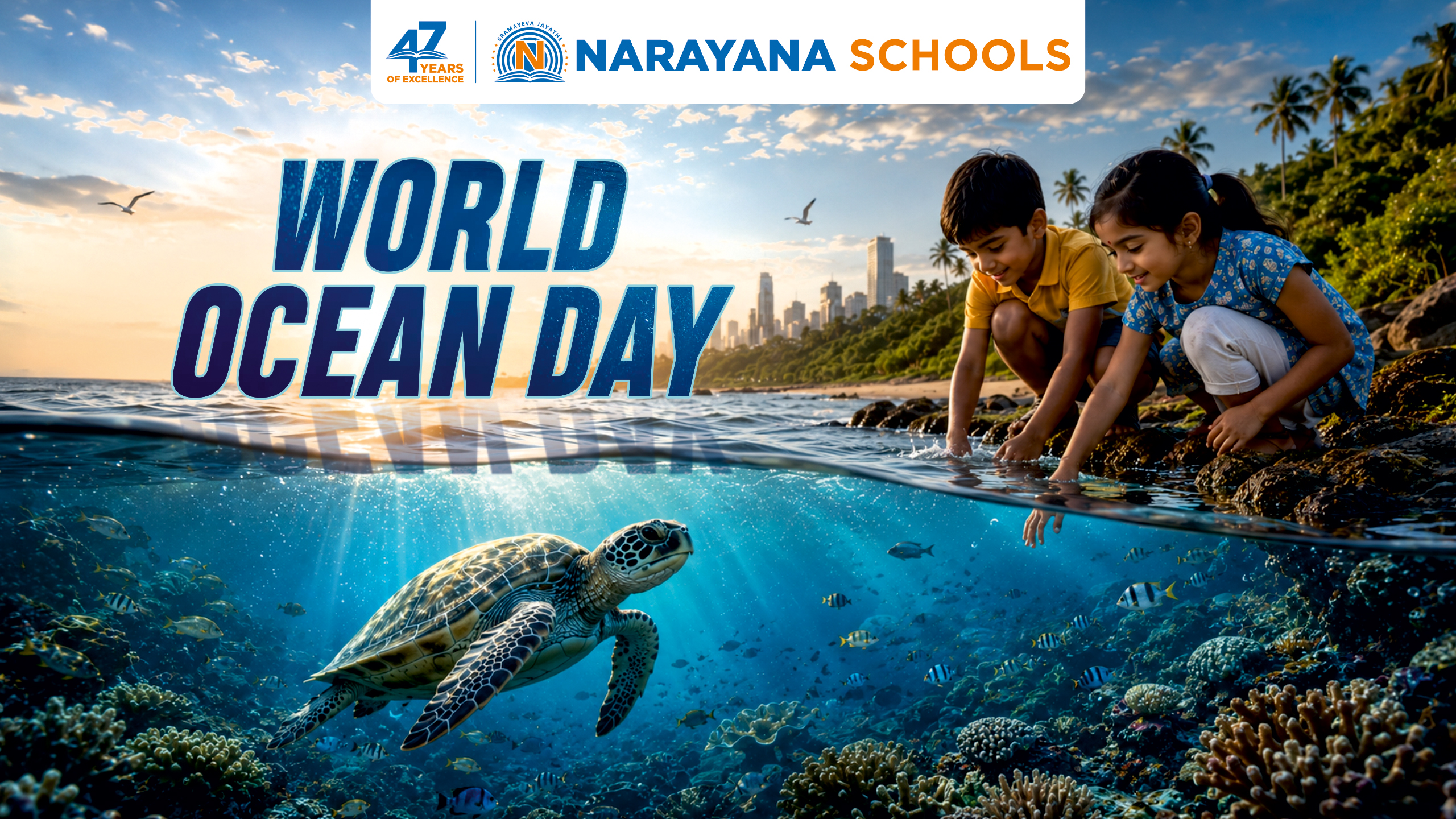
Observed every year on 8 June, World Ocean Day is a global reminder that oceans are not distant ecosystems. They are central to everyday life, climate stability and the future of children growing up today.
How it began?
- World Ocean Day was first proposed at the 1992 Earth Summit in Rio de Janeiro and was officially recognised by the United Nations in 2008.
- The date symbolises a unified global effort to protect oceans, which cover over 70% of the Earth’s surface.
- Oceans produce nearly 50% of the world’s oxygen, absorb about 30% of carbon dioxide emissions and regulate global temperatures.
- They act as Earth’s natural climate regulator, distributing heat through ocean currents.
- Over 3 billion people depend on marine biodiversity for food and livelihoods.
- Coral reefs and mangroves protect coastal populations from storms and erosion.
- The global ocean economy is valued at approximately $1.5 trillion annually.
- Oceans face critical threats such as marine pollution, overfishing, coral bleaching and biodiversity loss. Nearly 11 million tonnes of plastic pollution enter oceans every year.
- Oceans absorb over 90% of excess global heat, acting as buffers against climate change.
- Rising ocean temperatures are intensifying cyclones, disrupting monsoons and causing extreme weather events.
- Climate patterns like El Niño and La Niña are driven by changes in ocean temperatures in the Pacific, and significantly influence global weather. El Niño often leads to droughts and heatwaves, while La Niña can trigger heavy rains, floods and stronger monsoons, directly impacting countries like India.
- To promote sustainable ocean management, environmental awareness and collective responsibility.
- Early exposure helps children build environmental values and long-term sustainable habits.
- With a coastline of over 7500 km, India is highly vulnerable to changes in ocean health.
- Ocean warming impacts monsoon patterns, agriculture and food security.
- Rising sea temperatures are increasing the intensity of tropical cyclones.
- Sea level rise threatens coastal regions through flooding and erosion.
- More than 80% of the ocean remains unexplored.
- The ocean makes up about 99% of the planet’s living space by volume. It means that most of the space where living things can exist on Earth is inside the ocean.
- Phytoplankton in the ocean produce at least half of Earth’s oxygen.
- Encourage reduced use of single-use plastics (e.g., carrying reusable water bottles, using cloth bags, avoiding plastic straws and disposable cutlery).
- Support waste segregation and recycling at home.
- Choose sustainable seafood options where applicable (e.g., opting for locally sourced fish like sardines, mackerel, rohu or catla choosing shellfish such as mussels and oysters; avoiding overfished species like certain tuna varieties; and selecting responsibly sourced prawns or salmon).
- Promote water conservation habits.
- Engage children in ocean-themed projects, documentaries and eco-activities (e.g., making ocean ecosystem models, creating posters on marine conservation, watching Blue Planet or Our Planet, participating in DIY recycling activities). Participate in local clean-up drives or awareness campaigns.
Drop Your Comment

Kiaan gupta
June 08, 2026
Nice knowledge. Today's need
Shrisha Muley
June 08, 2026
We have to take care of our ocean be neat n clean always taking care.
See More