How Digital Classrooms Are Becoming The New Norm
24 Feb 2026
There once was a time when learning meant blackboard, chalk and heavy backpacks.
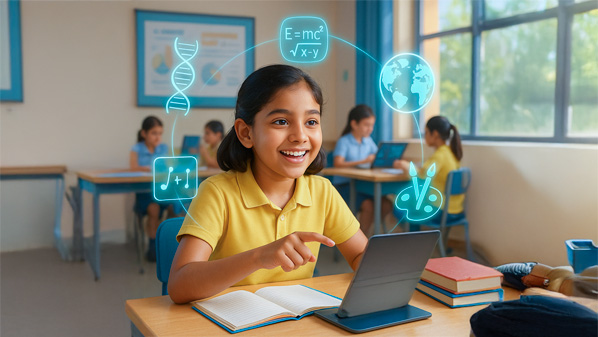
Today, brightly coloured rooms filled with smart screens and smiling faces welcome our children.
Teaching has become increasingly lively, clear and curiosity-driven. Digital classrooms are capable of helping every child learn more quickly and dream more broadly.
More than just a change in tools, it is a beautiful and welcome change in the field of education.
A New Dawn In Learning: How Classrooms Have Changed
Do you remember the good old days, when you, as a student, used to carry a bulky schoolbag and piles of notebooks? Chalk particles were sprinkled around and blackboards were at the centre of each classroom. Education was all about listening, memorising and noting down what the teacher wrote on the board. Things are different today. Kids enter bright rooms with big screens and colourful images. Teachers smile as they work on digital boards to turn even the most difficult lessons into easy and fun experiences. As parents, you could be feeling astonished and wondering, "How quickly education has transformed!" But this transformation is more than just screens or devices. It's about simplifying learning, making it joyful, and more meaningful. Digital classrooms are making every child learn more, and every teacher teaches better. Let's see what's so unique about these new-generation classrooms.What is a Digital Classroom?
A digital classroom is not merely a room with a computer or projector. It's an environment where teachers use smart tools such as interactive boards, videos, and apps to present lessons more clearly. Imagine this —- Kids observe the water cycle via animated videos rather than learning about it by reading from a book.
- Kids understand math concepts through animations and interactive technology on boards, rather than just solving sums on paper.
- Kids watch and listen to the recorded lessons at home when they miss school.
Why Are Digital Classrooms The New Normal In India
This change is spreading all over the nation, from the crowded schools of the metros to those in smaller cities. The New Education Policy (NEP 2020) has influenced schools to utilise technology to make learning more practical and innovative. But the truth is simple: the world is evolving, and our kids need to learn with it.- Parents desire their kids to be tech-savvy, not merely to play but to learn.
- Kids enjoy visual learning, and they learn better if they can see and hear.
- Schools desire to equip kids with a future where all work is technology-based.
How Digital Classrooms Bring Learning To Life
Imagine this: A teacher describes the solar system and on the screen, the planets begin to rotate. The children's eyes are bright as they feel mesmerised by the glowing red colour of Mars or the sparkle of Saturn's rings. Learning together comes to life. Students are divided into groups, writing on smart tablets, building ideas and solving puzzles. It develops teamwork and self-belief. Even the quiet ones join in. Quizzes and interactive games help the weaker students feel stronger. If they don't get it, they can re-watch lessons later. Every kid learns differently — some by seeing, some by listening and some through action. Digital classrooms enable teachers to teach every type of learner. Learning truly comes to life and is personal at last.The Hidden Benefits That Parents Often Ignore
Parents may see the screens but not the magic behind them. These are the hidden benefits of digital learning:- Kids discuss more about what they learned. Learning becomes a matter of pride for the family to boast about.
- Parents can monitor lessons and know how their child is progressing via online apps.
- It makes study time safer due to fewer outside tuition and more guided learning at home.
- Emotionally, parents are proud to observe their child learning in a modern, global manner.
- Most of all, it develops curiosity, a quality that lasts a lifetime.
- In the controlled school environment, this comes along with the important human touch that only teachers can provide.
Teachers: The Real Heroes Behind The Screens
A lot of people believe technology replaces teachers, but that's not so. Technology helps, but teachers still make the difference. Think of a small-town teacher learning to use smart boards for the first time. She practises late at night, determined to get a smile and a clearer understanding from her students. That's the real spirit behind each digital classroom. Teachers now employ videos, images, and real-life anecdotes to teach challenging subjects. Workshops and training keep them on their toes and informed. Behind each smart classroom, there is a smarter, more committed teacher.Overcoming The Challenges
Similar to each new concept, smart classrooms have some areas for improvement. Some of the schools experience internet problems or power outages. Gadgets require maintenance. Parents occasionally complain about excessive screen time. Schools, however, are discovering smart solutions.- Most of them implement hybrid teaching by combining books with technology.
- Teachers instruct students about safe and balanced screen use.
- Rural schools embrace cost-effective solar-powered devices.
What Should Parents Look for In A School With Digital Classrooms
When you tour a school, don't just see the glitz of the screens. Ask these basic questions:- Do the teachers explain the lessons well, and are they suitable for your child's age?
- Are teachers trained effectively to utilise digital tools?
- Does the school maintain a balance between screens, books, and handwriting?
- Can parents easily understand how their child is progressing at a parent-teacher meeting or by using an app?
- Do the children learn healthy screen habits and teamwork?
How Schools Are Setting The Trend
India has always had a love affair with learning. Now, the nation is spearheading another revolution, called online learning. Lots of schools are already integrating smart boards and e-learning laboratories. Students conduct science experiments through simulations, so difficult subjects become easy to understand. In villages, certain schools employ solar-powered equipment to provide lessons even during power failures. As of recent updates, approximately 65% of India's private schools have implemented digital learning environments, either in full or in part. India's young minds were always bright. With digital education, they are now shining brighter than ever.The Emotional Impact: A New Way Of Learning And Living
Digital classrooms are changing not just how our children learn, but also the way families think and interact.- Kids feel eager to go to school and share what they've learnt.
- Parents feel engaged, proud, and much more involved with their child's progress.
- Teachers feel valued for learning something new and positive, like new tools, and for their impact on a young mind.
- Communities feel hopeful about education in schools for our students in the future.
How Narayana School Is Building The Future With Digital Learning
In Narayana Schools, our principle is straightforward: "Learning must encourage curiosity, not fear."- All the classrooms here are a combination of technology and care.
- Smart boards, digital laboratories, robotics classes, and AI-powered resources make learning fun and simple.
- Teachers and parents remain connected through special apps and notifications.
- Every child receives personalised mentoring. No one is left out.
- Technology at Narayana is not used for flair. It's employed to make children feel more confident, creative, and future-ready.