
Loading...

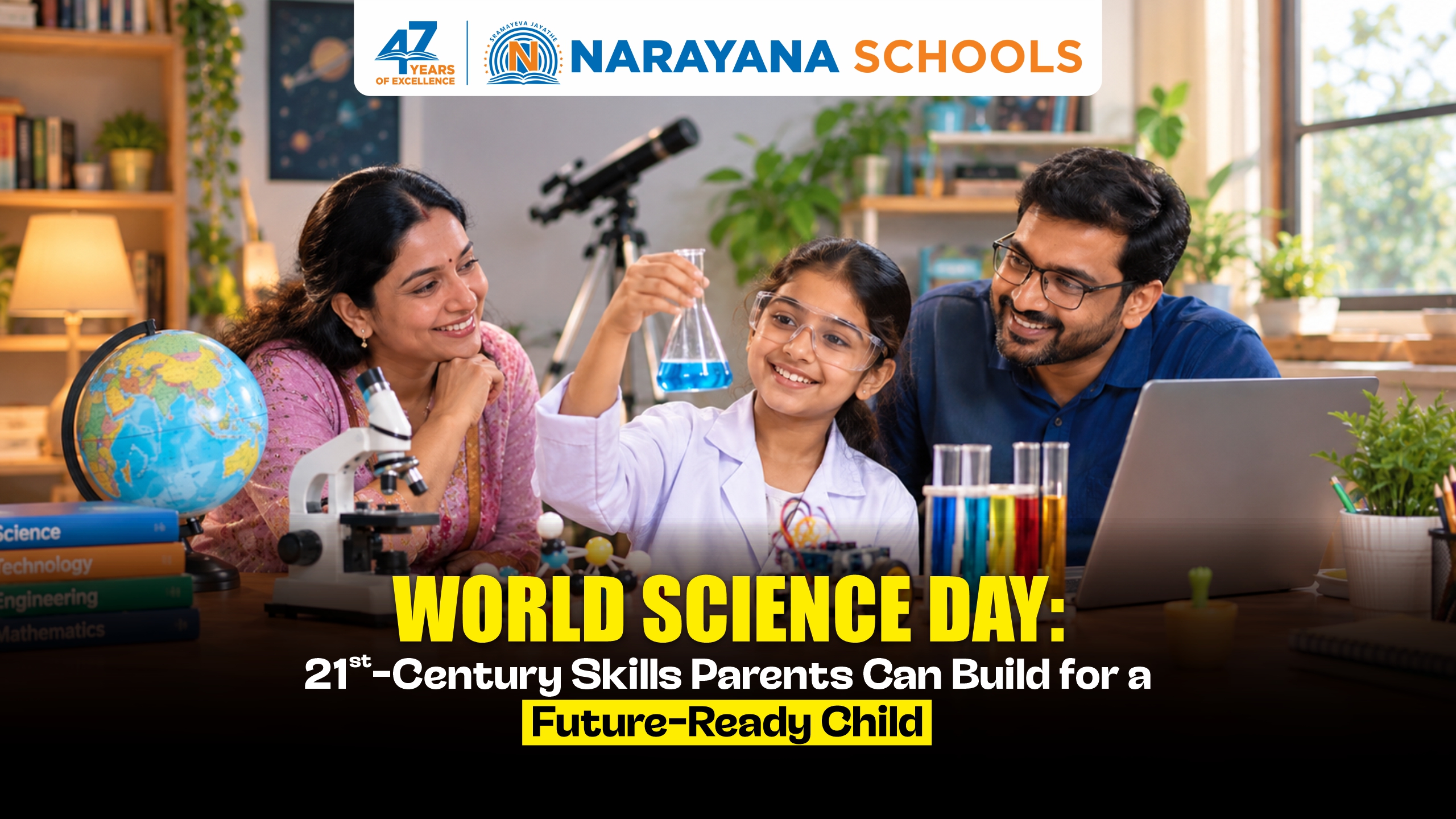
A child wondering why the sky changes colour, how UPI transfers money, how phones know where to go or what makes a rocket fly is already thinking like a young scientist. The challenge is to keep that curiosity alive and turn questions into skills for the future. In a world shaped by rapid scientific and technological advances, children need more than textbook knowledge. They need 21st-century skills that help them question information, solve problems, adapt to change and work with others.
Observed every year on 10 November, World Science Day for Peace and Development highlights the role of science in everyday life and in building peaceful, sustainable societies. United Nations Educational, Scientific and Cultural Organization (UNESCO) proclaimed the observance in 2001, and the first worldwide celebration took place in 2002.
The 2025 theme, Trust, Transformation, and Tomorrow: The Science We Need for 2050, highlighted the importance of public trust in science, evidence-based decisions and responsible innovation. The World Science Day 2026 theme, Common Ground Through Science Diplomacy, focuses on how scientific cooperation can connect countries and communities to address shared challenges.
These themes are particularly relevant in a world shaped by rapid advances in artificial intelligence, biotechnology, space exploration and digital communication. Children will need more than the ability to understand scientific concepts. They must also learn to question information, distinguish evidence from misinformation, approach unfamiliar problems creatively, use technology responsibly and work with people who have different perspectives. These abilities are closely connected to 21st-century skills.
The Partnership for 21st Century Learning (P21), now part of Battelle for Kids (US-based, non-profit organisation that works with education systems to advance student-centred learning and prepare learners with essential skills for the future), identifies 12 key skill areas across three categories: Learning and Innovation Skills, Information, Media and Technology Skills, and Life and Career Skills.
Here, we explore six particularly important skills that parents can nurture through everyday activities to help children become curious, adaptable and future-ready learners.
1. Critical thinking and problem-solving: Developing critical thinking for children begins with encouraging them to ask questions, examine information and think through challenges rather than accept answers at face value. For example, discuss a viral health claim and ask children to compare it with information from a trusted medical source before deciding whether it is reliable.
2. Curiosity and observation: Turn everyday experiences into opportunities to explore, investigate and understand how the world works. Ask children to observe how shadows change from morning to afternoon and record their findings to identify patterns.
3. Creativity and innovation: Encourage children to imagine different possibilities, experiment with ideas and find original ways to overcome challenges. Set a design challenge to build a paper bridge that can hold coins. Testing and improving the design helps turn creative thinking into practical innovation.
4. Digital and AI literacy: Help children understand how to use digital tools and artificial intelligence thoughtfully, recognise their limitations and evaluate the information they receive. Explain that AI-generated answers can be inaccurate and encourage verification through textbooks, teachers and reliable sources. Remind children never to share personal information online.
5. Communication and collaboration: Give children opportunities to exchange ideas, listen to different viewpoints, work towards shared goals and explain their thinking clearly. Invite siblings or friends to conduct a simple experiment together, discuss their observations and present the results as a team.
6. Scientific temper and responsibility: Nurture a habit of asking questions, seeking evidence and making informed decisions while understanding how individual actions affect the environment and society. Involve children in checking household electricity use, segregating waste or observing local biodiversity to connect scientific understanding with responsible everyday choices.
India's National Education Policy (NEP) 2020 emphasises experiential learning and critical thinking. A 2024 systematic review in Educational Research Review, examining 24 studies on open-inquiry science learning, identified benefits related to conceptual understanding, scientific thinking skills, motivation and science literacy.
At Narayana Schools, experiential learning, STEM activities and project-based exploration help connect classroom concepts with real-world applications. For Classes 1–2, activity-based learning encourages children to explore concepts through engaging activities, while Classes 3–5 focus on experiential learning that connects classroom concepts with practical experiences. These approaches are integrated into the eChamps programme (Classes 1–5) to strengthen conceptual understanding, develop essential learning skills and help build strong foundations.
The eTechno programme (Classes 6–10) further develops critical thinking, analytical abilities and problem-solving skills, preparing students for an increasingly competitive world. These learning experiences nurture future-ready skills, helping children approach new challenges with curiosity and confidence.
Raising a future-ready child is not about having every answer. It is about nurturing the confidence to ask questions, the patience to investigate and the willingness to work with others. By building these abilities, children can turn curiosity into capability and take meaningful steps towards fulfilling their dreams, because at Narayana Schools, your dreams are our dreams.
1. When is World Science Day observed?
Every year on 10 November.
2. What was the World Science Day 2025 theme?
Trust, Transformation, and Tomorrow: The Science We Need for 2050.
3. What is the World Science Day 2026 theme?
Common Ground Through Science Diplomacy.
4. Who developed the concept of 21st-century skills, and is there a universally recognised list?
There is no single universally agreed list of 21st-century skills. Several organisations have developed frameworks to define them. One influential example is the Partnership for 21st Century Learning (P21), established in 2002. Its framework identifies 12 skill areas across three categories: Learning and Innovation Skills, Information, Media and Technology Skills, and Life and Career Skills.
5. What are the 12 skill areas identified by the P21 framework?
They include creativity and innovation, critical thinking and problem-solving, communication, collaboration, information literacy, media literacy, ICT literacy, flexibility and adaptability, initiative and self-direction, social and cross-cultural skills, productivity and accountability, and leadership and responsibility.
6. What skills help children develop scientific thinking?
Six important skills that nurture scientific thinking in children are:
7. How can parents encourage scientific thinking at home?
By welcoming questions, trying simple experiments, discussing evidence and involving children in everyday problem-solving.
8. Are these skills useful only for developing scientific thinking?
No. These skills extend beyond scientific learning and support several aspects of a child's overall development, including academic learning, everyday decision-making, effective communication, teamwork and responsible use of technology. They help children become independent thinkers, confident learners and responsible individuals.


