Dussehra 2026: How India Celebrates Good Over Evil
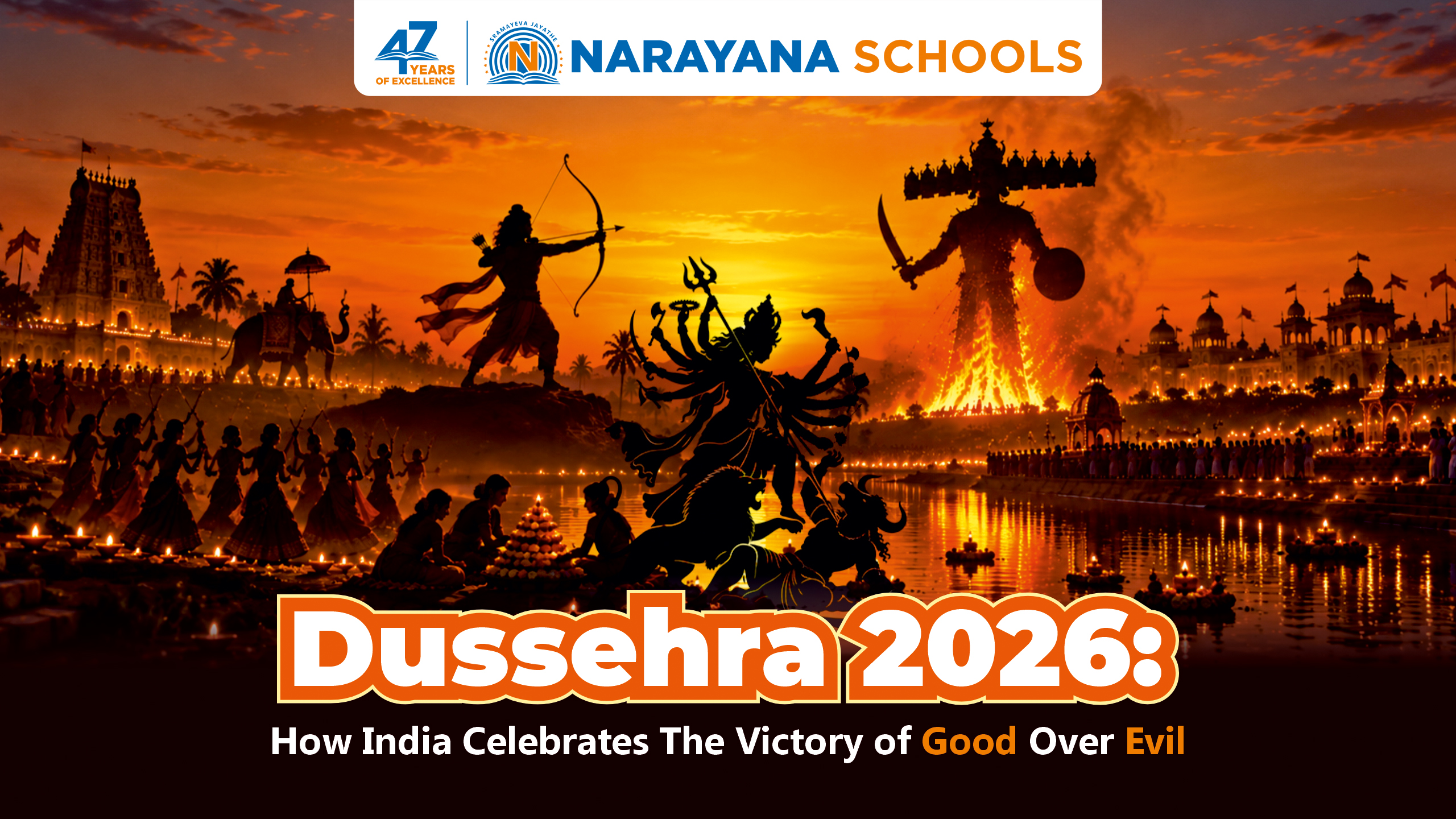
Every year, as the vibrant colours of Navratri reach their grand finale, millions of people across India prepare to celebrate Dussehra. In 2026, the festival falls on 20 October.
The word Dussehra is believed to have originated from the Sanskrit Dasha-Hara or Dasha-Harana, commonly interpreted as the defeat of the ten-headed Ravana. In the Ramayana, Lord Rama slays the demon king Ravana after a long battle to rescue his wife Sita, and this victory of dharma over adharma is celebrated on Dussehra. Its other name, Vijayadashami, translates to ‘the victory on the tenth day’, referring to the tenth day of the bright fortnight of the Hindu month of Ashwin. The day also honours Goddess Durga’s victory over the buffalo demon Mahishasura, as narrated in the Devi Mahatmya (Durga Saptashati). In that account, the goddess battles Mahishasura for nine nights and slays him on the tenth day. Together, these two stories give the festival its message that good ultimately triumphs over evil.
Yet Dussehra is much more than a single festival celebrated in one way. Travel across India and you will encounter different names, rituals and cultural expressions. Journey beyond India's borders and you will discover communities that honour related traditions inspired by the Ramayana, Goddess Durga and centuries of shared cultural heritage.
For students, Dussehra offers a fascinating lesson in history, culture and values. It reminds us that while customs may vary across regions, the ideals of courage, integrity and perseverance remain universal.
Dussehra Across India: Many Names, One Message
One of the most remarkable aspects of Dussehra is how differently it is celebrated across regions while preserving the same underlying values.
Andhra Pradesh: Vijayadashami
- In Andhra Pradesh, Vijayadashami is closely associated with the renowned Kanaka Durga Temple on Indrakeeladri Hill in Vijayawada.
- During the nine nights of Navaratri, devotees worship Goddess Kanaka Durga through elaborate Alankarams (the deity is adorned in a different form each day, such as Bala Tripura Sundari, Gayatri Devi, Annapurna Devi, Lalitha Tripura Sundari, Maha Chandi and Saraswati Devi).
- The Saraswati Alankaram, held on Moola Nakshatra, is the most crowded day of the festival.
- The Durga and Mahishasura Mardini forms are worshipped on Ashtami and Navami
- The celebrations culminate on Vijayadashami, when the goddess appears as Raja Rajeshwari Devi, with special poojas followed by the Theppotsavam, a ceremonial float festival in which the utsava murthis of the goddess and Lord Malleswara Swamy are taken on a decorated boat on the Krishna River.
Telangana: Bathukamma and Vijayadashami/Dasara
- In Telangana, Vijayadashami/Dasara is celebrated together with Bathukamma, the state’s colourful floral festival.
- Bathukamma is observed for nine days, beginning on Mahalaya Amavasya and ending on Durgashtami with Saddula Bathukamma.
- Women gather seasonal wildflowers such as tangedu (cassia), gunuka (celosia) and marigold, and stack them in concentric layers to form a conical floral mound, often topped with a small turmeric form of Goddess Gauramma.
- Dressed in traditional attire, women place their Bathukammas in open grounds and community spaces, sing folk songs while moving around them in circles, and celebrate nature and womanhood. In the evening, the Bathukammas are immersed in lakes and ponds.
- Vijayadashami follows the Bathukamma celebrations, with devotional rituals and family traditions such as Jammi (Shami) tree worship, where people exchange its leaves as symbolic gold and seek elders’ blessings.
West Bengal: Bijoya/Bijoya Dashami
- In West Bengal, Bijoya Dashami is celebrated on the 10th day and marks the conclusion of Durga Pujo, the state’s grandest festival.
- The celebrations begin with Mahalaya, when the goddess is invoked through the recitation of the Chandi Path, and with Akal Bodhan, the ceremonial awakening of Goddess Durga. The name means untimely awakening.
- Goddess Durga’s original worship, begun by King Surath, was held in spring during Chaitra Navratri and is still observed today as Basanti Pujo. According to Bengali tradition, Lord Rama invoked the goddess out of season, in Sharad Navratri, to seek her blessings before battling Ravana. Because this worship came before its traditional time, it is called Akal Bodhan, and it is the Durga Pujo that Bengal celebrates today.
- The main pujas are held from Shashthi to Dashami, with Bodhon on Shashthi, Sandhi Puja at the juncture of Ashtami and Navami, and elaborate pandals and idols across towns and cities.
- On Bijoya Dashami, married women perform Sindoor Khela, applying vermilion to the goddess and to one another, after offering her sweets and betel leaf in a farewell ritual known as Boron.
- The idols are then taken in processions for immersion in rivers and ponds, bidding Durga farewell as she returns to her marital home on Mount Kailash.
- Afterwards, people exchange Bijoya greetings, touch the feet of elders for blessings and share sweets such as rasgulla and sandesh.
Karnataka: Mysuru Dasara
- In Karnataka, Mysuru Dasara is celebrated as the Nadahabba, the state festival, and is the grandest expression of the state’s royal and cultural heritage.
- The ten-day celebrations begin with the inauguration of the festival and worship of Goddess Chamundeshwari atop Chamundi Hill, and conclude on Vijayadashami.
- The Mysuru Palace is illuminated with nearly one lakh bulbs and the city hosts cultural performances, music, dance, wrestling bouts, food fairs and exhibitions.
- The Golden Throne (Ratna Simhasana) is assembled for the private royal Durbar, which the Wadiyar family continues to hold.
- The festival culminates on Vijayadashami with the famous Jamboo Savari, a grand procession in which an idol of Goddess Chamundeshwari, placed in a golden howdah, is carried on a decorated elephant through the city to Bannimantap, where the Banni tree is worshipped.
- The royal traditions associated with Mysuru Dasara trace their roots back over four centuries to the Vijayanagara Empire, and were later carried forward by the Wadiyar kings of Mysore from the early 17th century.
Himachal Pradesh: Kullu Dussehra
- In Himachal Pradesh, Kullu Dussehra starts on the 10th day, unlike other regions where the celebrations conclude on that day.
- The festival is held at the Dhalpur Maidan in Kullu and lasts seven days.
- It opens with a grand procession in which Lord Raghunath (Lord Rama), the presiding deity of the Kullu valley, is carried in a decorated chariot (ratha) and pulled by devotees.
- Hundreds of local deities from neighbouring valleys are ceremonially brought in palanquins to pay homage to Lord Raghunath, and the gathering is often described as a Devta Sammelan (assembly of deities).
- The festival is accompanied by folk music, traditional dances such as the Kullvi Nati, local handicrafts and cultural programmes.
- On the final day, the Lanka Dahan ritual is performed, symbolising the victory of good over evil, and the deities return to their villages.
- The tradition dates back to the 17th century, when Raja Jagat Singh installed the idol of Lord Raghunath in Kullu.
- The festival is celebrated as one of India’s most distinctive Dussehra celebrations.
Chhattisgarh: Bastar Dussehra
- In Chhattisgarh, Bastar Dussehra stands apart from the Rama-centred traditions commonly seen elsewhere.
- The festival honours Goddess Danteshwari, the presiding deity of Bastar, and showcases the region’s rich tribal heritage.
- It is celebrated for around 75 days, making it one of the longest festivals in the world, and does not involve the burning of Ravana.
- The celebrations begin with Pata Jatra, the ritual worship of the sacred wood used to build the festival chariot, and the Kachan Gadi ceremony, in which a young girl from the Mirgan community is believed to be possessed by the goddess and gives her permission to hold the festival.
- The highlight is the Rath Yatra, in which a massive wooden chariot, built by tribal communities using traditional methods, is pulled through Jagdalpur by hundreds of villagers.
- Other key rituals include Jogi Bithai, Muria Darbar and Kutumb Jatra.
- The festival concludes with the Mawli Parghav, where the deity is bid farewell, and the Doli Vidai.
- Tribal communities such as the Muria, Maria, Halba and Dhurwa take part, along with deities from nearby villages.
- The tradition dates back over six centuries, to the time of the Kakatiya dynasty rulers of Bastar in the 15th century.
Delhi and Northern India: Ramleela and Ravan Dahan
- Across Delhi and much of northern India, Dussehra is characterised by Ramleela, dramatic performances that depict episodes from the Ramayana.
- The Ramleela is staged over nine or ten nights during Navaratri, with the story unfolding from Rama’s birth and exile to the abduction of Sita and the battle with Ravana.
- It is performed by local theatre groups and community committees, often in open grounds and accompanied by music, dialogue and elaborate costumes.
- In Delhi, well-known Ramleelas are held at the Ram Leela Ground, Red Fort grounds and Luv Kush Ramleela at Lal Qila, and the tradition is also strong in cities such as Varanasi, Ayodhya, Lucknow and Mathura.
- The celebrations culminate on Vijayadashami with Ravan Dahan, in which towering effigies of Ravana, his son Meghnad and his brother Kumbhakarna are filled with firecrackers and set alight, symbolising the victory of truth and virtue over evil.
- The effigies are typically set ablaze after a symbolic enactment of Rama’s arrow striking Ravana.
- The Ramnagar Ramlila near Varanasi, staged for around a month, is recognised by UNESCO as part of the Intangible Cultural Heritage of Humanity, and the Ramlila tradition of Uttar Pradesh was inscribed in 2008.
Although Dussehra may not be celebrated in the same way in every place, the values embodied by Durga Puja, the Ramayana and Dussehra resonate across cultures and communities worldwide. Their enduring messages of good triumphing over evil, courage overcoming adversity and righteousness prevailing over wrongdoing continue to inspire people across borders. At Narayana Schools, nurturing cultural understanding, courage and self-discipline alongside academic learning helps students grow with confidence, overcome challenges and move towards fulfilling their dreams, because your dreams are our dreams.
FAQs
- What is Dussehra and why is it celebrated? Dussehra, also called Vijayadashami, is a Hindu festival celebrated on the tenth day after Navaratri begins, marking the victory of good over evil. In much of North India it commemorates Lord Rama’s victory over Ravana, while in other regions it marks Goddess Durga’s victory over the demon Mahishasura.
- How is Dussehra celebrated in different parts of India? Dussehra is celebrated differently across India, with each region following its own traditions. In Delhi and North India, Ramleela performances end with Ravan Dahan. In West Bengal, it is Bijoya Dashami, marked by Sindoor Khela and idol immersion. Karnataka hosts the Mysuru Dasara with the Jamboo Savari procession, Telangana celebrates alongside Bathukamma, Andhra Pradesh worships Goddess Kanaka Durga at Vijayawada, Himachal Pradesh holds Kullu Dussehra, and Chhattisgarh observes the 75-day Bastar Dussehra.
- Are Dussehra and Bijoya Dashami the same? Dussehra and Bijoya Dashami fall on the same day but are celebrated with different customs. Bijoya is the Bengali form of Vijaya (victory). In West Bengal, the day marks the farewell to Goddess Durga at the end of Durga Puja, while in much of North India it centres on Rama’s victory over Ravana.
- Which place is most famous for Dussehra celebrations in India? Mysuru in Karnataka is among the most famous Dussehra destinations, known for its illuminated palace and Jamboo Savari procession. Other well-known celebrations include Kullu in Himachal Pradesh, Bastar in Chhattisgarh, Kolkata’s Durga Puja, and the Ramleela and Ravan Dahan events in Delhi.
- Why is Ravana’s effigy burnt on Dussehra? Ravana’s effigy is burnt on Dussehra to symbolise the destruction of evil and the victory of truth and virtue. The ritual follows the Ramleela performances and re-enacts Rama’s defeat of Ravana, often with effigies of Meghnad and Kumbhakarna alongside. Not every region follows this practice; Bastar, Kullu and Mysuru, for example, observe Dussehra without it as the central ritual.