Girls in STEM: What Parents Can Do Between Class 6 and Class 10
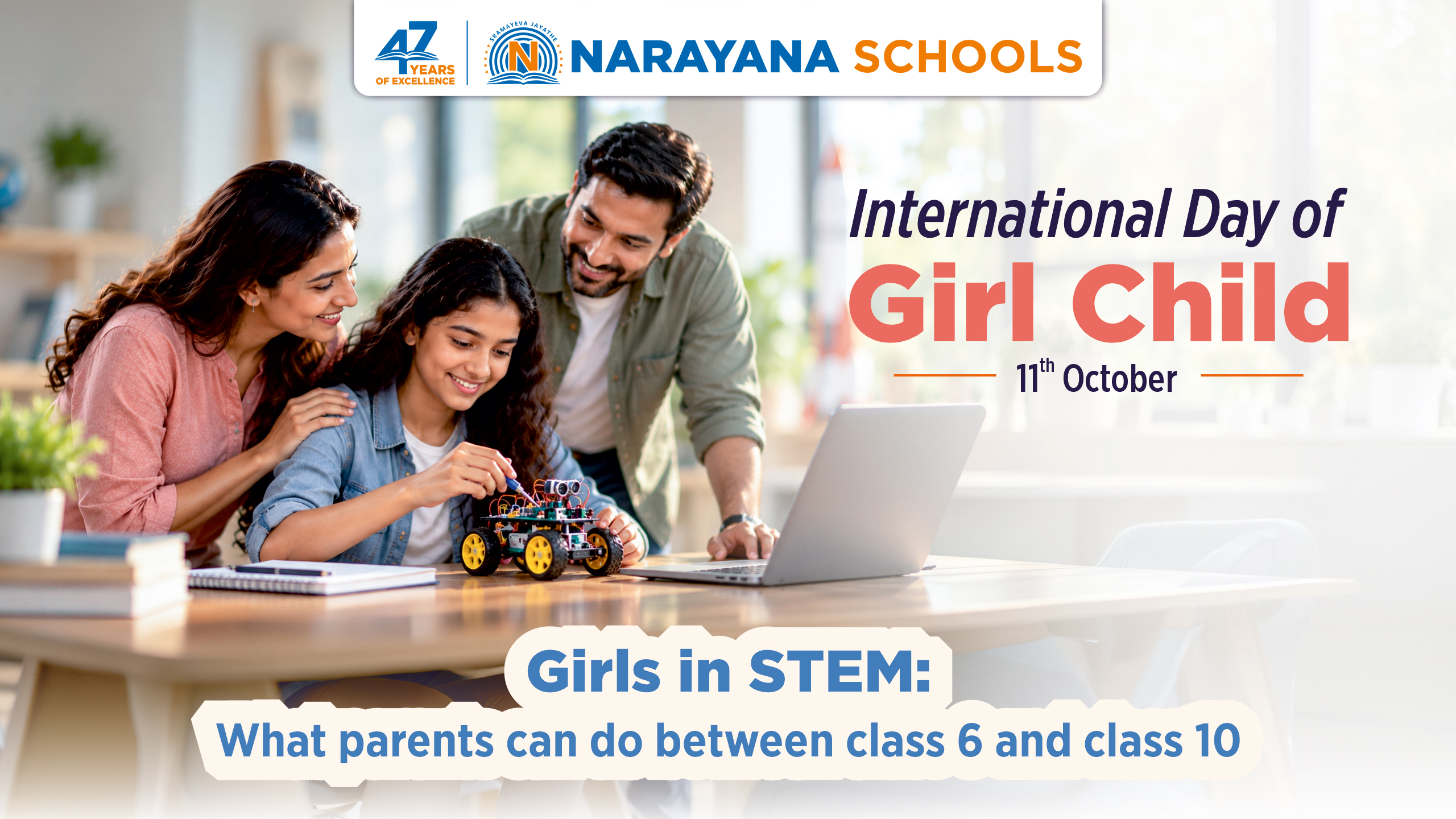
International Day of the Girl Child, observed on 11 October, highlights the importance of creating opportunities that enable girls to learn, grow and realise their potential. In today's technology-driven world, one of the most powerful ways to empower girls is by encouraging participation in Science, Technology, Engineering and Mathematics (STEM) from an early age.
India has made encouraging progress in this area. According to the All India Survey on Higher Education (AISHE) 2023-24, women accounted for 44% of STEM enrolment in higher education. However, despite strong participation at the education level, women continue to be underrepresented in many STEM research and leadership careers. This highlights the importance of nurturing confidence, curiosity and scientific thinking during the formative years.
The period between Class 6 and Class 10 is particularly important because it is often when students begin developing subject preferences, career aspirations and perceptions about their own abilities. With the right encouragement from parents, schools and society, girls can build the confidence needed to explore STEM opportunities and pursue their interests without limitations.
- Challenge stereotypes early
- The transition from Class 6 to Class 10 can influence how girls see their abilities.
- A 2024 meta-analysis by David I. Miller and colleagues, covering 98 studies and 1,45,204 children across 33 countries, found that gender stereotypes were particularly strong around computer science, engineering and physics and became more pronounced among girls with age.
- Parents can counter this by avoiding phrases such as ‘boys are naturally better at technology’ and praising curiosity, persistence and problem-solving instead.
- What Parents Can Do for Their Children Who Are in Classes 6 to 10? A. Make STEM hands-on
- Building a simple circuit, coding a game, observing the Moon, analysing household electricity use or testing materials can turn abstract concepts into discoveries.
- Research by Allison Master and colleagues found that hands-on programming experiences increased technology interest and self-efficacy among girls.B. Bring female STEM role models closer
- A study by Susana González-Pérez, Ruth Mateos de Cabo and Milagros Sáinz, involving 304 girls aged 12 to 16, found that exposure to female STEM professionals improved mathematics enjoyment, expectations of success and STEM aspirations while reducing gender stereotypes.
- Indian role models such as Tessy Thomas, Gagandeep Kang, and women scientists including Ritu Karidhal Srivastava, Muthayya Vanitha and other contributors to India's space missions can help girls see STEM as a field in which women can contribute, lead and innovate.C. Encourage Curiosity, Independent Exploration and Participation in Competitions and STEM Communities
- Support activities that allow girls to ask questions, investigate ideas and seek solutions.
- Science documentaries, museums, astronomy clubs, coding platforms and innovation challenges can deepen interest beyond textbooks.
- Focus on learning and discovery rather than only grades and outcomes.
- Olympiads, science exhibitions, coding competitions and innovation contests help girls develop analytical thinking, confidence and problem-solving skills.
- Participation also exposes them to like-minded peers and mentors who can inspire future STEM aspirations.
- Government initiatives supporting girls in STEM
To encourage greater participation of girls and women in STEM, the Government of India has introduced several initiatives, like:
- Vigyan Jyoti: Encourages girls from Classes 9-12 to pursue STEM education through science camps, mentoring, laboratory visits and interactions with STEM professionals.
- Women in Science and Engineering - Knowledge Involvement in Research Advancement through Nurturing (WISE-KIRAN): Supports women through fellowships, research opportunities and career development programmes in STEM.
- All India Council for Technical Education (AICTE) Pragati Scholarship for Girl Students: Provides financial assistance to girls pursuing technical and professional education.
- Let Class 6 to 10 be an exploration window
Narayana Schools' eTechno programme for Classes 6 to 10 supports STEM learning through a structured approach that helps students strengthen concepts, develop analytical thinking and apply knowledge to real-world problems.
- Strong foundations in Mathematics and Science: Builds conceptual understanding though CDF (Concepts, Definitions and Formula) to help students approach challenging STEM topics with confidence.
- Structured learning through microschedules: Organises learning into manageable steps, supporting consistency and progressive understanding.
- Regular assessments and performance analysis: Helps identify learning gaps, correct errors and strengthen problem-solving skills.
- Olympiad preparation and competitive exposure: Encourages logical reasoning, analytical thinking and the ability to tackle unfamiliar questions.
- Science laboratories and practical learning: Gives students opportunities to connect scientific concepts with experiments, observations and applications.
- Technology-enabled learning through nLearn: Narayana Schools’ nLearn digital learning platform supports students in strengthening subject concepts and practising problem-solving at their own pace.
These learning experiences can make STEM education for girls more engaging and accessible, helping them recognise that scientific and mathematical abilities develop through practice, guidance and persistence. Equal opportunities to participate, explore and innovate can encourage girls to consider a wider range of future STEM pathways. At Narayana Schools, nurturing curiosity, confidence and scientific thinking through meaningful STEM experiences helps girls explore possibilities, build capabilities and move towards fulfilling their dreams, because your dreams are our dreams.
FAQs
- Why are Classes 6 to 10 important for girls in STEM? These years can influence confidence, subject interests and future academic choices.
- How can parents encourage girls to explore STEM? Provide equal access to experiments, technology, competitions, books, mentors and STEM role models without attaching subjects to gender.
- Does a girl need to be naturally good at mathematics for STEM? No. STEM skills develop through conceptual understanding, practice, problem-solving and persistence.
- How can schools support girls in STEM? Hands-on learning, laboratories, Olympiad preparation, mentoring and inclusive opportunities can help sustain STEM interest.