World Space Week 2026: How to Turn Your Child's Space Curiosity into Real Science
From questions about black holes to fascination with rockets, space often sparks a child’s first encounter with science.
This makes World Space Week 2026 an ideal opportunity for parents to transform curiosity into meaningful learning. Celebrated globally from 4-10 October, World Space Week was proclaimed by the United Nations in 1999 to honour the contribution of space science and technology to humanity. The dates commemorate the launch of Sputnik 1 on 4 October 1957 and the coming into force of the Outer Space Treaty on 10 October 1967. The 2026 theme, Rocket Revolution, highlights how advances in rocket technology are making space more accessible than ever before.
With the right guidance, space curiosity can become a pathway to observation, experimentation and scientific thinking. 5 Ways to Turn Space Interest into Real Scientific Thinking
1. Encourage Questions and Not Just Answers
Research in science education consistently shows that inquiry-led learning improves understanding and retention. Instead of explaining everything, encourage children to ask:
- Why do rockets need fuel?
- How do astronauts live in space?
- Why does the Moon appear different each night?
This develops critical thinking skills, the foundation of scientific discovery.
2. Connect Space with Everyday Life
Many children do not realise that space technology powers Global Positioning System (GPS) navigation, weather forecasting, disaster monitoring and telecommunications. Linking classroom science to daily life helps build practical understanding of STEM education and its real-world impact.
3. Follow India’s Space Journey
India provides a powerful source of inspiration. ISRO's Chandrayaan-3 Moon landing, the Aditya-L1 solar mission and continued launch vehicle innovations have demonstrated how world-class science can emerge from Indian classrooms and laboratories. India was also the first country to reach Mars orbit on its maiden attempt through Mangalyaan and has developed NavIC, its own satellite navigation system. India’s space story is now expanding beyond government-led missions. Skyroot Aerospace, a Hyderabad-based private space company, successfully launched Vikram-1 on 18 July 2026, marking the first orbital launch by a private Indian company from Indian soil. The four-stage rocket carried multiple payloads into Low Earth Orbit, demonstrating the growing capabilities of India’s private space sector. With upcoming missions such as Gaganyaan and advances in space docking technologies, India continues to expand the boundaries of exploration, innovation and private participation in space.
These achievements help children view science not as a distant dream but as a realistic career pathway.
4. Replace Passive Screens with Active Exploration
Simple activities can make a significant difference:
- Night-sky observation journals
- Moon-phase tracking
- Model rocket projects
- Space documentaries followed by discussions
- Science exhibitions and astronomy club participation
Hands-on experiences strengthen scientific reasoning far more effectively than passive consumption.
5. Build Strong Foundations in Mathematics and Science
A study published in Nature Human Behaviour found that early interest in science often predicts later engagement in STEM fields. However, curiosity alone is not enough. Consistent development of mathematics, physics and problem-solving skills is essential for future scientists, engineers and innovators.
6. Why World Space Week Matters for Indian Parents?
As India expands its space ambitions, future careers will increasingly require expertise in space science, robotics, artificial intelligence, engineering and data science. World Space Week provides a timely reminder that nurturing scientific thinking can begin at any age and in any classroom.
7. How Narayana Schools Turns Space Curiosity into Real Science?
At Narayana Schools, space curiosity comes alive through STEM-focussed learning, Olympiad preparation, scientific enquiry, innovation-driven activities, competitive academic programmes and experiential learning opportunities that encourage students to think beyond textbooks and explore the possibilities of the universe.
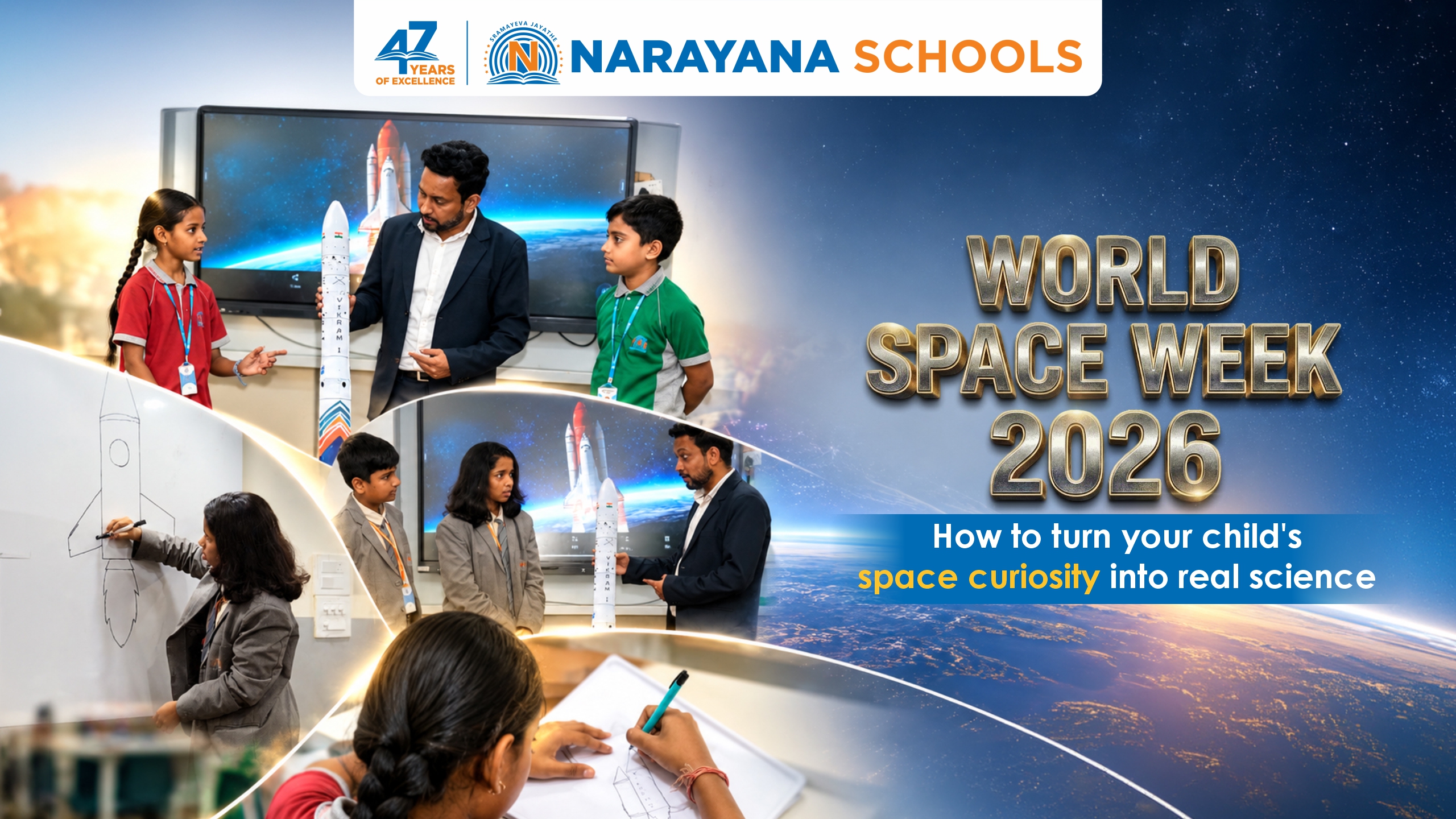
This year, in line with the World Space Week 2026 theme, Rocket Revolution, Narayana Schools conducted an interactive session to sensitise students to the rapid advances in rocket technology and India's growing space capabilities. The successful Vikram-1 mission by Hyderabad-based Skyroot Aerospace was used as a real-world example to inspire students, spark curiosity and encourage them to explore how science, technology and innovation can turn ambitious space ideas into reality.
NSS Space Competitions (National Space Society)
- Narayana Schools students take part in global competitions of the National Space Society, including the Space Settlement Contest (formerly run by NASA).
- It provides opportunities for students to engage with space-related concepts, imagine future habitats and explore ideas connected to space science, engineering and human settlement beyond Earth.
- Narayana students won a record 99 awards in the 2024-25 edition.
International Olympiad on Astronomy and Astrophysics (IOAA)
- Narayana Schools' focus on scientific excellence also extends to international astronomy competitions.
- At the 19th International Olympiad on Astronomy and Astrophysics (IOAA) 2026, held in Hanoi, Vietnam, Narayana Schools students Akshat Srivastava, Pranjal Dixit and Sumant Gupta won Gold Medals for India as part of the five-member Indian team. Their achievement reflects the depth of scientific understanding, problem-solving ability and astronomical knowledge required to compete at the global level.
The Four Club Framework
Beyond the regular curriculum, some campuses of Narayana Schools has structured co-curricular learning into a dedicated four club framework, designed to develop future-ready learners through hands-on, meaningful and joyful experiences:
- Pixel Palette: A digital creativity club where students explore design, digital art and visual storytelling.
- Synergy X: A STEM and aerospace focused club encouraging hands-on experimentation, engineering thinking and scientific exploration. This is where space curiosity truly takes flight, with students building, testing and tinkering like young engineers.
- Idea Vault: A club centred on financial literacy, entrepreneurship and innovation, helping students think like builders and problem solvers.
- Global Vox: A public discourse and diplomacy club that builds articulation, global awareness and confident communication.
Guided by the EDGE framework, Explore, Design, Grow and Excel, these clubs take students from curiosity towards deeper application through interactive, activity-based experiences. The journey culminates in Clubs Culmination, Narayana Schools' annual celebration where students showcase the skills, ideas and projects developed through the clubs.
Every practice and initiative at Narayana Schools stems from one belief: that a child's curiosity, nurtured well, can grow into real science and a dream fulfilled, because your dreams are our dreams.
Frequently Asked Questions
- What is World Space Week and when is it celebrated? World Space Week is celebrated globally from 4-10 October. The United Nations proclaimed it in 1999 to honour the contribution of space science and technology to humanity. The dates mark the launch of Sputnik 1 on 4 October 1957 and the Outer Space Treaty coming into force on 10 October 1967. The 2026 theme is Rocket Revolution.
- How can I turn my child's interest in space into real scientific thinking? Encourage questions rather than only giving answers, and connect space to everyday life through GPS, weather forecasting and telecommunications. Replace passive screen time with active exploration such as night-sky journals, Moon-phase tracking and model rocket projects. Alongside this, build strong foundations in mathematics, physics and problem-solving.
- Why is mathematics important for children interested in space science? Curiosity sparks interest, but it is not enough on its own. Consistent development of mathematics, physics and problem-solving skills is essential for future scientists, engineers and innovators. These skills help children move from asking "what happens?" to understanding "why does it happen?"
- How does Narayana Schools support students interested in space and science? The eChamps programme (Classes 1-5) uses activity-based learning in Classes 1-2 and experiential learning in Classes 3-5. The eTechno programme (Classes 6-10) builds depth in science and mathematics along with Olympiad preparation. Students also take part in National Space Society competitions. In Synergy X, the STEM and aerospace club, they experiment, build and test ideas like young innovators.