
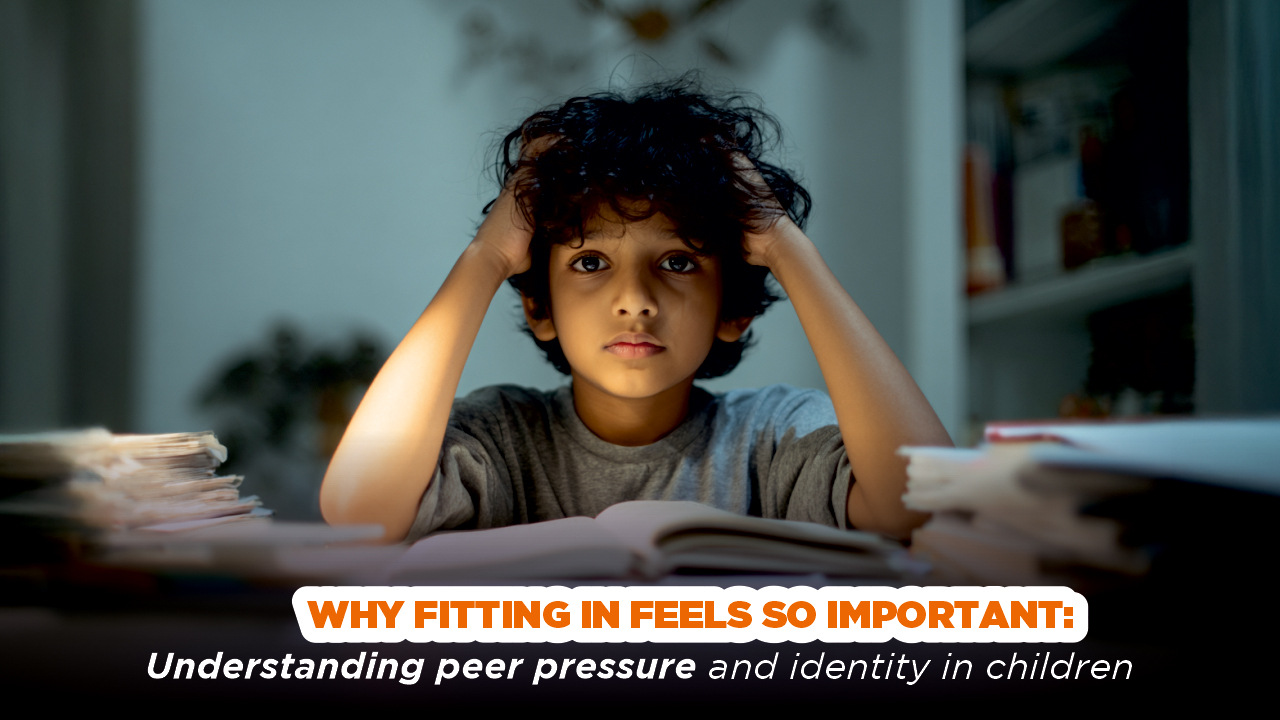
The shift in behaviour in children often begins with something small, a sudden change in hairstyle, a sudden disinterest in a beloved cartoon, the quiet replacement of a colourful lunchbox with a more ‘grown up’ one or the urge to belong to a certain group on the playground. These subtle shifts are not just about changing preferences, they reflect the invisible but powerful pull of peer pressure.
Peer pressure refers to the influence exerted by a peer group that encourages individuals, especially children, to change their attitudes, values, or behaviours in order to conform and gain acceptance. In the school environment, it can manifest in everyday choices, from fashion and friendships to academic competition and behaviour.
For school age children, especially within India’s socially dynamic and achievement-oriented landscape, the need to fit in can become deeply intertwined with the need to be accepted. Recognising this urge is not about criticising it, it is about understanding how it shapes identity and offering steady, empathetic guidance through it.
What Drives Peer Pressure?
Peer influence plays a powerful role in shaping adolescent habits. A study in Karnataka found that nearly 44% of adolescents reported strong peer influence affecting their behaviour either positively or negatively. While peer pressure can motivate improved academic performance and social skills, it may also lead to undesirable behaviours such as unsafe choices, social withdrawal or conformity against one’s better judgement.
So, what exactly drives peer pressure?
1. Social Identity Formation: During school-age years, children begin forming a personal identity, often shaped by social surroundings. According to Social Identity Theory (Tajfel & Turner, 1979), individuals derive self-worth and belonging from group membership. This desire to be part of the ‘in-group’ compels many children to adapt behaviour, preferences and even values that align with their peers.
2. Neurobiological Factors: Research in developmental neuroscience reveals that the prefrontal cortex, responsible for decision-making and self-regulation, is still maturing in children and adolescents. At the same time, the limbic system, which processes emotions and rewards, is highly active. This imbalance makes school age children more sensitive to peer validation and emotional cues, especially when acceptance or rejection is at stake (Blakemore & Mills, 2014).
3. Fear of Exclusion: Children often conform due to fear of social rejection. The idea of being left out or labelled as ‘different’ activates stress responses that, evolutionarily speaking mimic physical pain. This results in heightened anxiety and the tendency to ‘fit in’ at any cost, even if it goes against personal values or safety.
4. Cultural Expectations and Collective Mindsets: In collectivist cultures (shared social identity) like India, community perception and familial reputation hold significant value. Children are socialised early to prioritise group harmony over individual expression. Peer pressure thus becomes a means of preserving social coherence, sometimes at the expense of personal comfort or authenticity.
5. Digital Amplification: With increased exposure to social media, children are now more frequently comparing themselves with others. This digital peer environment intensifies traditional peer pressure through curated images of ‘ideal’ lifestyles, academic achievements and social approval measured in likes and comments.
Identity Formation Through the Lens of Jungian Archetypes
While neuroscience explains the external pressures children face, Carl Jung’s theory of archetypes offers an internal perspective on why peer pressure feels so personal. Jung proposed that we inherit universal mental patterns, archetypes, that shape how we think, feel and behave. During adolescence, a time when children seek belonging and identity, these archetypes become more active. Peer pressure then is not just external, it often reflects a child’s deeper, unconscious alignment with symbolic roles they are beginning to embody.
Key Archetypes in School-Age Children
1. The Innocent: Motivated by the desire to be liked, accepted and protected.
• Children resonating with this archetype often follow rules, seek adult approval and try to conform to peer norms to avoid disapproval.
• Peer pressure manifests as compliance, often saying ‘yes’ even when unsure just to remain part of the group.
2. The Hero: Driven by challenge, success and validation.
• These children strive to be the best, academically, socially or physically to gain peer admiration.
• Peer pressure here is often performance based, children may overextend themselves in academics or sports to meet perceived group expectations.
3. The Rebel: Defined by independence and resistance to control.
• These individuals might oppose norms, break rules or adopt contrary behaviours not always out of defiance but as an assertion of self.
• Peer pressure for the Rebel often appears as a reactionary stance, pushing boundaries even when the consequences are risky.
4. The Caregiver or Helper: Feels fulfilled when taking care of others or being useful in group settings.
• These children may become overly involved in others’ problems or take on burdens not their own.
• Peer pressure arises when emotional manipulation or guilt is used to ensure compliance or support.
5. The Everyman (or Girl/Boy Next Door): Yearns to belong and avoid standing out.
• Children with this archetype blend easily into groups and reflect the values of their environment.
• Peer pressure becomes particularly influential because blending in often means agreeing (even silently) with prevailing group behaviour.
Recognising Identity and Its Pressures
Encouraging self-awareness helps children understand why fitting in feels essential. Observe for signs such as:
• Constant changes in behaviour or wardrobe to match friends
• Reaching for approval through conformity, even at personal cost
• Discomfort when standing apart from the group
Research shows that adolescents often form friendships within their same socio-economic groups. As parents, encourage discussions around values and boundaries, emphasising the importance of being true to oneself.
Narayana Schools’ Role: Building Identity with Emotional Anchoring
At Narayana Schools, two significant initiatives empower children to navigate peer pressure while building self-awareness:
1. DISHA Mental Well-being Programme: This structured programme gives students a safe space to share feelings, manage stress and develop resilience. By promoting open conversations with 1,00,000+ trained counsellors, DISHA helps children recognise emotional triggers linked to peer pressure and regain inner balance.
2. Yoga Veekshan: Through daily breathing, mindfulness and movement, Yoga Veekshan helps children pause, reflect and realign themselves amidst peer challenges. These practices reinforce emotional control and identity clarity, especially when external pressures mount.
Practical Guidance for Parents
1. Foster Open Dialogue: Ask about friendships and situations where children feel pressured.
2. Discuss Archetypes: Help children see their own tendencies, whether they lean towards the Hero, the Innocent or others.
3. Strengthen Identity: Encourage pursuits that align with a child’s passions and values.
4. Build Assertiveness: Role-play scenarios where peer pressure arises and discuss how to say ‘no’ respectfully.
5. Create a Supportive Environment: Celebrate individuality and discourage comparisons.
As parent–child bonds are the strongest counterbalances to peer influence, studies affirm that involvement at home reduces the risk of negative behaviours. Helping children navigate peer pressure involves balancing community belonging with authentic self-expression, even as Jungian archetypes swirl beneath the surface of their personalities. When children feel secure in their identities, they can embrace belonging without losing themselves.
We believe that we have a responsibility to help children honour their true selves in the midst of external noise as that is where dreams take shape, not in imitation but in authenticity, because at Narayana Schools, your dreams are our dreams.
It’s fascinating to see how early the desire to fit in starts to shape children’s behavior. Even small shifts, like changing their favorite shows or lunchbox, can be the first indicators of peer pressure affecting their self-identity.
Please send in video form
I completely agree with the article and I think every children should feel the peer pressure.
Thank you so much Narayana for raising the matter and also for solution how you handle it.
I appreciate it.
Thanks so much
This information and guidance very useful for me and also adolescent students parents..
This post really captures how those seemingly smallBlog comment creation changes in a child’s choices often signal something deeper going on socially. It’s interesting how peer pressure at this age can shape identity so subtly, long before kids are even aware it’s happening. I think it’s important for parents and teachers to spot these shifts early so they can guide children toward finding belonging without losing their individuality.
This article really nails the subtlety of peer pressure, especially in school-age children. It makes me wonder how we can create environments where children feel more secure in their identity and less susceptible to the pressures around them.
You’ve really outdone yourself with this one. Brilliant!