
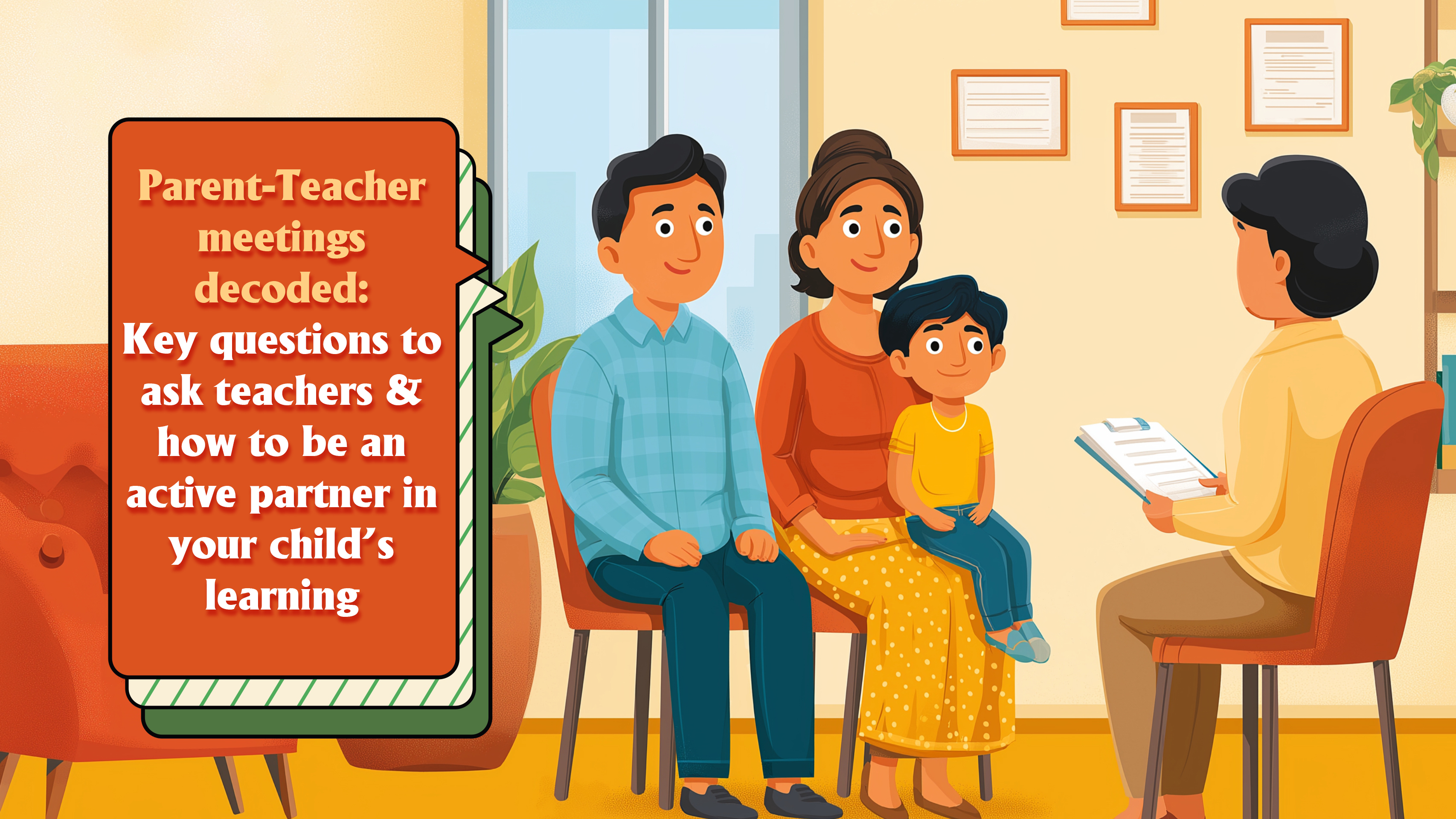
Parent-Teacher Meetings (PTMs) are more than just calendar events. They serve as collaborative checkpoints between home and school, ensuring learners remain not only academically sound but emotionally and socially supported. Especially as children’s learning needs continue to grow and change, meaningful PTMs can act as the bridge between intent and impact, allowing schools and families to walk hand in hand with clarity and care.
The Purpose Behind the Meeting
Research from the Harvard Family Research Project shows that students with engaged parents are more likely to earn higher grades, attend school regularly and display better behaviour and social skills. At the heart of these results lies the quality of communication between parents and educators, and PTM is the most direct channel.
But what makes a PTM meaningful? It is not just about hearing subject-wise marks or behavioural feedback. It is about decoding the child’s learning patterns, identifying early signs of academic stress, and strategising ways to boost confidence, consistency and curiosity.
Additionally, PTMs provide an opportunity to explore a child’s individual interests and strengths not just in academics but beyond it too. When teachers and parents openly exchange observations about a student’s preferences, be it in certain subjects, science experiments, creative writing, problem-solving, sports, music, drama or debating, it enables targeted reinforcement at home. This understanding allows families to support skill-building in areas where a child naturally thrives, fostering a stronger sense of motivation and purpose in learning.
What Should Be Asked but Often Is Not Asked?
A Parent-Teacher Meeting (PTM) is a powerful opportunity to uncover deeper insights into a child’s academic, emotional and social growth. Here are some essential yet often overlooked questions every parent should consider asking:
A. Learning Style and Classroom Engagement
1. How does my child learn best, visually, audibly or through hands-on practice?
2. Does my child thrive better in structured environments or open ended activities?
3. What are the current classroom strategies being used and how can we reinforce them at home?
B. Social Interaction and Group Dynamics
1. How does my child interact with peers during group work or free play?
2. Is my child an introvert or extrovert in the classroom setting?
3. Is my child able to form and maintain friendships easily?
C. Personality and Interest Discovery
1. What activities or subjects does my child show the most enthusiasm for?
2. Have you noticed any talents or creative inclinations worth nurturing?
3. Based on your observations, what are my child’s interest areas?
3. Are there any signs of leadership, empathy or innovation?
D. Emotional Well-being and Behaviour
1. How is my child’s general mood or emotional state during school hours, is he/she cheerful, moody or withdrawn?
2. Do they show signs of mental fatigue, trouble concentrating or irritability that comes with using devices excessively or academic stress?
3. How do you promote self-confidence and emotional safety in class?
4. Has there been any change in behaviour, attitude or performance since the last PTM or previous year?
E. Academic Performance
1. To the Class Teacher:
1.1 Is my child’s overall performance satisfactory in class and assessments?
1.2 Which subject(s) does my child show interest in or struggle with?
1.3 How does my child perform in class participation, discipline, and assignments?
2. To Subject Teachers:
2.1 How well is my child grasping concepts in your subject?
2.2 Are there specific topics my child finds difficult? Can we support this at home?
2.3 Do you have any recommended books, apps, or materials to help?
2.4 How frequently are tests conducted and how does my child perform?
F. Language and Communication
1. Is my child a good reader? Are they able to comprehend and express themselves effectively?
2. Are there any challenges in understanding second or third languages?
3. Would you consider differentiated support for non-native language learners?
G. Homework and Study Habits
1. Is my child regular and focused while completing homework?
2. How much time should ideally be dedicated to homework daily?
3. Is there a structured homework schedule you follow?
H. Parent’s Role and Reinforcement
1. How can I align with your teaching style to support my child’s learning at home?
2. What strategies can I use to help build self-study habits?
3. How can I prepare my child better for tests or assignments?
4. Would sharing more about my child’s home habits, interests or sensitivities help you in any way?
I. Sensitive and Situational Concerns
1. Are there any concerns regarding my child that I should be aware of, be it emotionally, behaviourally or socially?
2. Would you like to know about any family situations or changes that may be affecting my child?
3. What is the school’s policy on bullying or conflict resolution? How are such matters usually handled?
How to Make PTMs More Impactful?
At Narayana Schools, we believe in regular and open communication, hence regular PTMs are not just a physical activity that takes place face-to-face once in a while rather they are the foundation of meaningful collaboration. Every parent here is a proactive participant in their child’s progress through system like the Adoption Calling Initiative, where continuous feedback loops are maintained between educators and families even outside scheduled PTMs.
Moreover, Narayana Schools’ PTMs do not just provide a one-way report, they welcome observations from parents as well. Class teachers connect with families through a fortnightly Adoption Call to share achievements and discuss any challenges. Each quarter, parents sit down for a Parent‑Teacher Meeting (PTM) and review a detailed portfolio of worksheets and projects. If something needs attention in between, a meeting with the Vice Principals or Principals can be scheduled at a convenient time through the school office to discuss and address any concern. Whether a child is unusually distracted at school and home, shows signs of anxiety before assessments or struggling with a subject that did not previously pose issues, such insights help both parents and teachers personalise learning paths.
The Power of Collaboration
Educational psychologist Dr. Joyce Epstein from Johns Hopkins University argues that true academic success is anchored in school-family partnerships. Analogous to tuning a musical instrument, when home and school operate at the same frequency, a child performs at their melodic best.
It is not just about questioning but co-creating, understanding how to create consistent routines, manageable revision schedules, balanced screen time, and ample emotional breathing room. Equally important is recognising and nurturing a child’s interest areas, which can serve as motivation anchors, helping them engage more deeply and joyfully with learning both inside and outside the classroom.
It is often forgotten that education is not a race but a roadmap. A roadmap where parents and teachers are co-navigators, constantly checking the compass, correcting the course and ensuring the journey is enriching and not exhausting.
At Narayana Schools, every PTM, every conversation and every shared insight is part of a bigger dream; a dream to nurture responsible, resilient and remarkable individuals, because, your dreams are our dreams.
The idea that PTMs act as a bridge between intent and impact really resonated with me. It reframes the meeting as a shared opportunity rather than a one-sided update, encouraging more open and thoughtful conversations between parents and teachers.
PTM anedi only photo s group lo pettadaniki kaadu now a days child parent daggara yentha time gaduputhunnado same teacher tho kuda….. So mana pillala gurinchi manaku yentha theluso teacher ki kuda anthe thelusu …..so parent and and teacher iddaru kuda child gurinchi discuss chesukunte better…. Not only studies……
Feedback should be improved from teachers side. Helps in identifying the strength and weakness of a student.
Teachers should encourage students to find subjects in day to day application also
Happy with children but as my daughter is in 9th i feel she need counselling from disha team to improve her studies
Regards
Hajira
Very helpful ….. thank you for sharing this with us.
Really a nice article… I would really apply this in next PTM…
Informative
“Ma’am/Sir, I really want to support my child more at home. But I’m struggling to make them interested in studies. Could you guide me on how I can increase their interest and help them score full marks or at least improve their academic performance?”
Good positive thoughts! Actually parents and school system should act as buttressing walls for the development of a child. They are not competitors; but the stakeholders to build the nation. Liked the content ?
Very informative.. Will going to apply in future ptm for sure. Thanks for sharing.
Very informative Article. Thanks for sharing. From next time while attending ptm I will keep these points in my mind .
Thanks for your support.
This Article is very Usefull to us.
New admission
Man/sir. My son study in your school but last 6 Month no have PTA meeting. And my child has not improved