
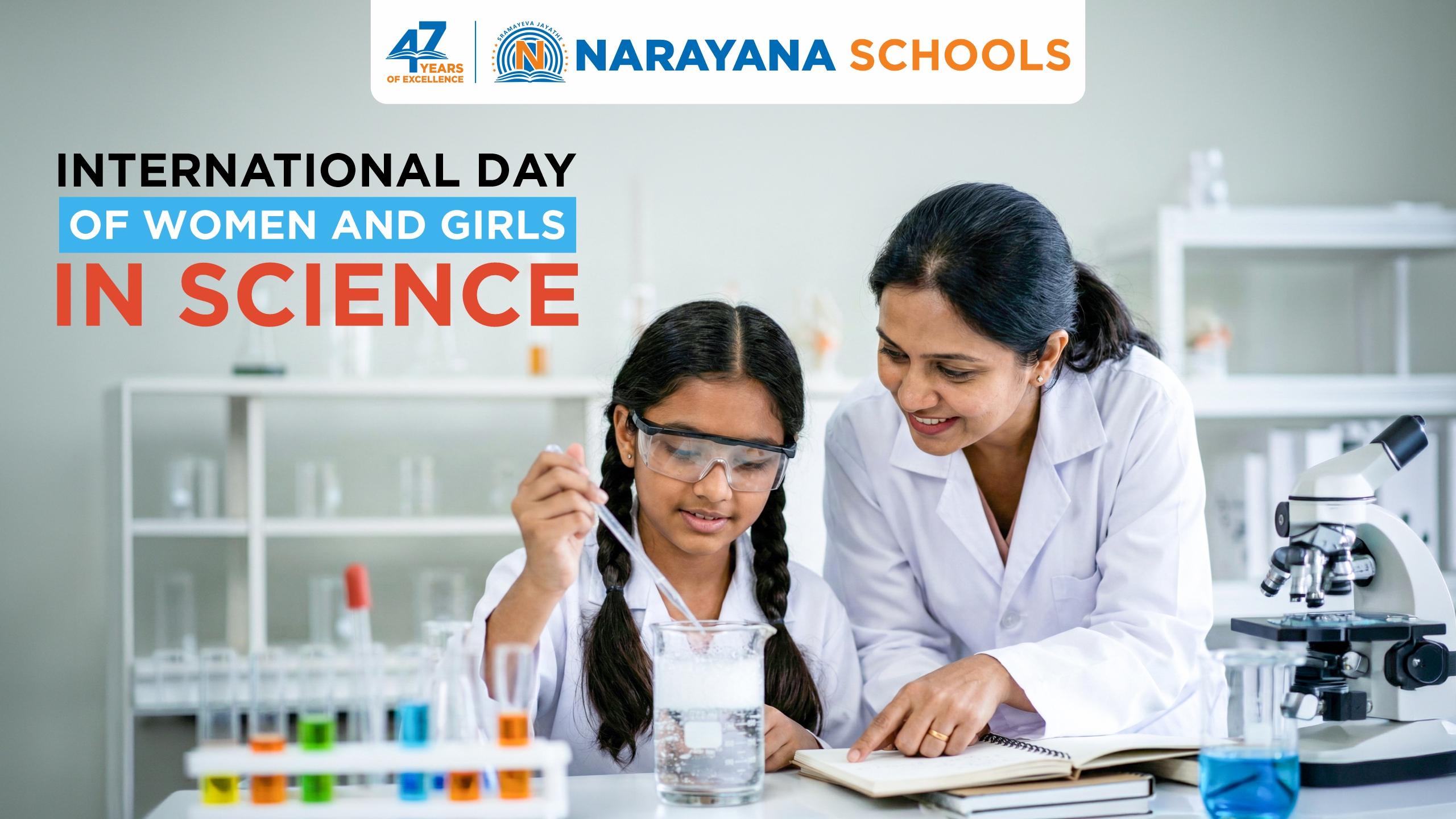
Observed every year on 11 February, the International Day of Women and Girls in Science highlights the importance of gender equality in science education and the need to build an inclusive ecosystem for future innovation. The date was designated by the United Nations in 2015 to support the 2030 Agenda for Sustainable Development, particularly SDG (Sustainable Development Goal) 4: Quality Education and SDG (Sustainable Development Goal) 5: Gender Equality. For families across India, this day reinforces the importance of nurturing scientific curiosity and confidence from an early age.
1. Why Representation in Science Matters
United Nations Educational Scientific and Cultural Organization (UNESCO) data shows that women make up less than one-third of the global scientific workforce, despite equal ability and potential. Research consistently proves that women in STEM fields strengthen innovation, improve problem-solving and contribute to socially relevant scientific advancements, which are critical for India’s long-term growth.
2. The Science Behind Early Encouragement
Developmental psychology studies reveal that attitudes towards science education for girls form during primary schooling. Children encouraged to explore, question and experiment develop stronger critical thinking skills and sustained interest in STEM learning.
3. Some Role Models Who Changed the Narrative
Across India and the world, several women have reshaped science and innovation, proving that curiosity, courage and capability know no gender or borders.
| Name | Country | Field | Key Contribution and Significance |
| Kalpana Chawla | India/ USA |
Space Science and Aerospace Engineering | First woman of Indian origin in space, and symbolised global scientific participation and perseverance. |
| Tessy Thomas | India | Missile Technology and Defence Science | Known as the ‘Missile Woman of India’ and led Agni missile projects, breaking gender barriers in defence research. |
| Dr. Gagandeep Kang | India | Medical Research and Virology | Global authority on rotavirus research and the first Indian woman elected Fellow of the Royal Society (UK). |
| Dr. Ritu Karidhal | India | Space Science (ISRO) | Key leader in Mars Orbiter Mission and Chandrayaan-2. She is popularly known as the ‘Rocket Woman of India’. |
| Marie Curie | Poland/France | Physics and Chemistry | The only scientist to win Nobel Prizes in two different sciences and a pioneer of radioactivity research. |
| Jane Goodall | UK | Primatology and Conservation Science | Transformed the understanding of animal behaviour through long-term chimpanzee research in Africa. |
| Katherine Johnson | USA | Mathematics and Space Science | NASA mathematician whose calculations enabled early spaceflights and lunar missions. |
| Rosalind Franklin | UK | Molecular Biology | Made critical contributions to the discovery of DNA’s double-helix structure and in shaping modern genetics. |
| Jennifer Anne Doudna | USA | Biochemistry and Molecular Genetics | Co-developer of the CRISPR-Cas9 gene-editing technology, revolutionised genetic research and medicine. |
Educational research confirms that visible women scientists as role models significantly raise aspiration levels among students.
4. An Indian Story That Shows Why Breaking Barriers Matters
Dr. Gagandeep Kang’s journey as one of India’s foremost virologists demonstrates how scientific excellence can emerge despite limited resources and entrenched gender barriers. Beginning her medical research career at a time when advanced laboratory infrastructure, funding, and female representation in leadership were scarce, she worked in a system where women were severely underrepresented in senior scientific roles, limiting access to visibility and mentorship.
Undeterred, Dr. Kang focused on translational research with real-world impact, balancing rigorous fieldwork in underserved communities with long-term academic inquiry. Her pioneering contributions to rotavirus epidemiology and vaccine research significantly strengthened India’s public health response to childhood diarrhoeal diseases. These achievements led to global recognition, including her election as the first Indian Woman Fellow of the Royal Society (United Kingdom), affirming a powerful truth: when education systems remove bias and invest in talent, innovation becomes inclusive and transformative.
5. How India Is Encouraging Girls in Science
The Government of India has introduced targeted programmes to strengthen the participation of women and girls in STEM education and research, addressing both access and long-term retention.
- Vigyan Jyoti is a flagship initiative aimed at encouraging school-going girls, particularly from Classes IX to XII, to pursue science, technology, engineering and mathematics. The programme provides mentorship, academic exposure, counselling and role model interaction, helping girls build confidence and informed career pathways in science from an early stage.
- WISE (Women in Science and Engineering) is a comprehensive framework designed to support women scientists who may face career breaks or systemic barriers. It offers research grants, fellowships and re-entry opportunities, enabling skilled women to continue contributing to scientific research and innovation.
- KIRAN (Knowledge Involvement in Research Advancement through Nurturing) focuses on empowering women researchers by providing structured support for skill development, leadership training and advanced research opportunities. The programme aims to increase women’s representation in senior scientific roles and decision-making positions.
- INSPIRE Scholarship (Innovation in Science Pursuit for Inspired Research) supports academically strong students, including a significant number of girls, from the age of 17 onwards, encouraging sustained engagement in basic and natural sciences through higher education and research pathways.
- CBSE and State Government Merit Scholarships for Girls in Science provide financial assistance, fee waivers and academic incentives to reduce dropouts during senior secondary education, particularly in STEM streams.
- AICTE Pragati Scholarship for Girls offers financial support to girls pursuing technical education at diploma and degree levels, addressing economic barriers that often limit participation in engineering and technology programmes.
- Post-Matric Scholarships for Girls in STEM across multiple states focus on first-generation learners, ensuring continuity from school to college by supporting tuition, learning resources and living expenses.
6. International Scholarships and Global STEM Initiatives for Girls
Beyond national efforts, several global programmes aim to create equal access to science education and research opportunities for girls worldwide.
- UNESCO-L’Oréal for Women in Science Programme supports young women researchers through fellowships, mentorship and international recognition, strengthening global representation in scientific leadership.
- British Council STEM Scholarships for Women enable women from countries like India to pursue postgraduate STEM education in the United Kingdom, particularly in underrepresented disciplines.
- Google Generation Scholarship and Microsoft Scholarship Programmes provide financial aid, mentorship and industry exposure for girls and young women pursuing computer science, engineering and data sciences.
- UNICEF and OECD backed Global Education Initiatives focus on closing gender gaps in STEM education through policy advocacy, curriculum reform and access to digital learning for girls in developing regions.
Together, these national and international efforts reinforce a shared global commitment: ensuring that talent, curiosity and scientific potential are nurtured irrespective of gender, from classrooms to research laboratories.
7. Building Confidence Without Pressure
Organisation for Economic Co-operation and Development (OECD) studies highlight that supportive parental involvement in education enhances motivation and resilience. Curiosity-led learning, hands-on experiments and encouragement over comparison foster long-term engagement with science and innovation.
8. Preparing for the Future Through STEM
The World Economic Forum identifies STEM skills, scientific literacy and analytical thinking as essential for future careers. Inclusive science education in India equips children to thrive in a technology-driven world.
The International Day of Women and Girls in Science underscores a powerful message: when access, encouragement and opportunity align, science becomes a shared pathway to progress, equity and limitless possibility.
Initiatives like the International Day of Women and Girls in Science are so important in inspiring the next generation of innovators. By encouraging girls to pursue their passions in STEM, we’re not just empowering them, but also building a more inclusive and diverse future for science.