
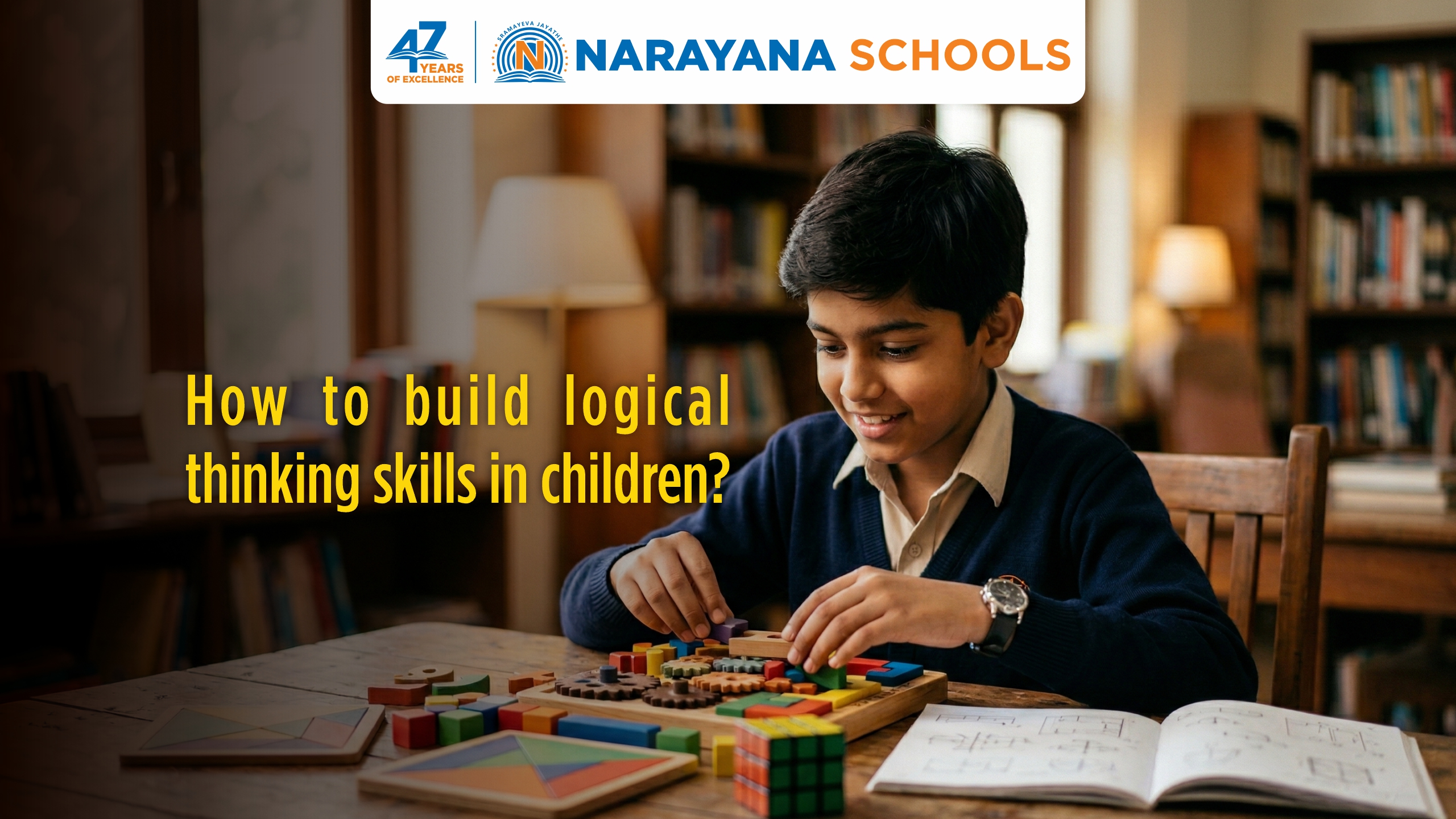
In today’s rapidly evolving world, logical thinking skills in children are no longer optional, they are essential for academic success, competitive exams and future careers. Research by the Organisation for Economic Co-operation and Development (OECD) highlights that problem-solving, reasoning and analytical thinking are among the most critical 21st-century skills. The focus, therefore, lies in gradual, structured and consistent development.
- Why logical thinking matters?
- Logical thinking forms the foundation of mathematics, science, coding and decision-making.
- Studies in educational psychology show that strong thinking skills improve academic performance, comprehension and adaptability.
- It enables children to analyse situations, identify patterns and make informed decisions.
- The science behind logical thinking
- Cognitive research shows that active problem-solving strengthens neural pathways, improving memory and understanding.
- Activities involving patterns, puzzles and reasoning enhance executive functioning, including planning and attention control.
- Gradual exposure prevents cognitive overload and supports long-term retention and conceptual clarity.
- Building logical thinking at home
- Encourage puzzles, strategy games and mental maths to develop pattern recognition and reasoning.
- Promote discussion-based learning by asking ‘why’ and ‘how’ questions to stimulate analytical thinking.
- Connect concepts to real-life situations, helping children apply logic beyond textbooks.
- Maintain structured routines that balance practice with reflection.
- Free platforms that strengthen logical skills
| Platforms | Age Group | Description | URL |
| Khan Academy | 8–18 years | Builds conceptual clarity through step-by-step problem-solving. | https://www.khanacademy.org/ |
| Code.org | 6–16 years | Develops computational and logical thinking through coding. | https://code.org/ |
| Blockly Games | 7–14 years | Uses visual logic puzzles for beginners. | https://blockly.games/ |
| Scratch | 7–14 years | Encourages creativity alongside logical sequencing. | https://scratch.mit.edu/ |
- Gradual and age-appropriate development
- Start with simple pattern recognition and games in early years.
- Progress to structured problem-solving and coding-based logic.
- Introduce higher-order reasoning tasks during secondary stages.
- This phased approach ensures confidence, consistency and deeper understanding.
- Ensuring the right approach
- Focus on understanding rather than speed or rote memorisation.
- Select platforms and activities that are interactive, distraction-free and age-appropriate.
- Monitor progress through application of concepts rather than scores alone.
- Encourage persistence, as logical thinking develops over time through practice.
In essence, building logical thinking skills in children is a gradual and continuous process rooted in science, structure and real-world application. When supported with the right mix of home strategies and free online learning platforms, children develop the ability to think critically, solve problems effectively and adapt confidently, preparing them not just for examinations but for life.
As a parent and educator, I appreciate how this post emphasizes the importance of nurturing logical thinking early on. It’s reassuring to see the focus on structured development rather than rote learning, especially with the growing emphasis on 21st-century skills like problem-solving and analytical thinking. The mention of OECD research really underscores why building these skills is so critical for long-term academic and career success.
Hi there, You’ve done an incredible job. I?ll certainly digg it and personally suggest to my friends. I am sure they’ll be benefited from this site.
I do agree with all the ideas you have presented in your post. They’re really convincing and will definitely work. Still, the posts are very short for starters. Could you please extend them a bit from next time? Thanks for the post.
Great write-up, I?m regular visitor of one?s site, maintain up the excellent operate, and It’s going to be a regular visitor for a lengthy time.
You really make it appear so easy together with your presentation however I find this matter to be actually one thing which I believe I’d by no means understand. It seems too complex and very vast for me. I am taking a look forward in your next put up, I will try to get the hold of it!
Hi, Neat post. There is a problem along with your web site in internet explorer, may test this? IE nonetheless is the market leader and a large element of other folks will leave out your excellent writing due to this problem.
It’s the best time to make some plans for the future and it is time to be happy. I have read this post and if I could I wish to suggest you few interesting things or suggestions. Perhaps you can write next articles referring to this article. I desire to read more things about it!
I’m really enjoying the design and layout of your site. It’s a very easy on the eyes which makes it much more pleasant for me to come here and visit more often. Did you hire out a designer to create your theme? Excellent work!
I was very happy to seek out this web-site.I wished to thanks to your time for this glorious read!! I definitely enjoying each little bit of it and I have you bookmarked to take a look at new stuff you blog post.
I’m extremely impressed with your writing skills and also with the layout on your blog. Is this a paid theme or did you customize it yourself? Either way keep up the excellent quality writing, it is rare to see a great blog like this one nowadays..
Do you mind if I quote a few of your articles as long as I provide credit and sources back to your site? My blog site is in the very same area of interest as yours and my users would really benefit from a lot of the information you present here. Please let me know if this ok with you. Thanks a lot!
It is truly a nice and useful piece of information. I am glad that you simply shared this helpful info with us. Please keep us informed like this. Thanks for sharing.
I’ve come across that nowadays, more and more people are attracted to camcorders and the industry of digital photography. However, as a photographer, it’s important to first invest so much time deciding the model of photographic camera to buy as well as moving from store to store just so you could buy the most affordable camera of the trademark you have decided to settle on. But it won’t end there. You also have to take into account whether you should obtain a digital digital camera extended warranty. Thanks alot : ) for the good suggestions I received from your site.
Thanks for your write-up. I also believe that laptop computers have gotten more and more popular these days, and now are often the only sort of computer included in a household. Simply because at the same time they are becoming more and more inexpensive, their working power is growing to the point where they can be as powerful as desktop computers coming from just a few years back.
Thanks for your posting. I also believe that laptop computers have gotten more and more popular these days, and now are sometimes the only type of computer utilised in a household. This is because at the same time they are becoming more and more cost-effective, their computing power is growing to the point where there’re as highly effective as pc’s out of just a few years back.
great issues altogether, you simply received a logo new reader. What would you recommend in regards to your submit that you made some days in the past? Any sure?
Great post but I was wondering if you could write a litte more on this topic? I’d be very grateful if you could elaborate a little bit further. Bless you!
This is a excellent website, could you be interested in doing an interview regarding just how you developed it? If so e-mail me!
I’m really impressed with your writing skills and also with the layout on your weblog. Is this a paid theme or did you customize it yourself? Either way keep up the excellent quality writing, it is rare to see a nice blog like this one nowadays..
Great beat ! I wish to apprentice while you amend your web site, how could i subscribe for a blog website? The account helped me a acceptable deal. I had been a little bit acquainted of this your broadcast provided bright clear idea
This is really interesting, You’re a very skilled blogger. I have joined your feed and look forward to seeking more of your excellent post. Also, I have shared your website in my social networks!
Hello there, I found your blog via Google while searching for a related topic, your site came up, it looks great. I have bookmarked it in my google bookmarks.
There may be noticeably a bundle to learn about this. I assume you made sure good factors in features also.
whoah this blog is excellent i like studying your posts. Stay up the good work! You realize, a lot of persons are hunting around for this information, you could aid them greatly.
I just added this site to my feed reader, great stuff. Can’t get enough!
Very nice post. I simply stumbled upon your blog and wanted to mention that I’ve really loved surfing around your blog posts. In any case I will be subscribing on your rss feed and I hope you write once more soon!