
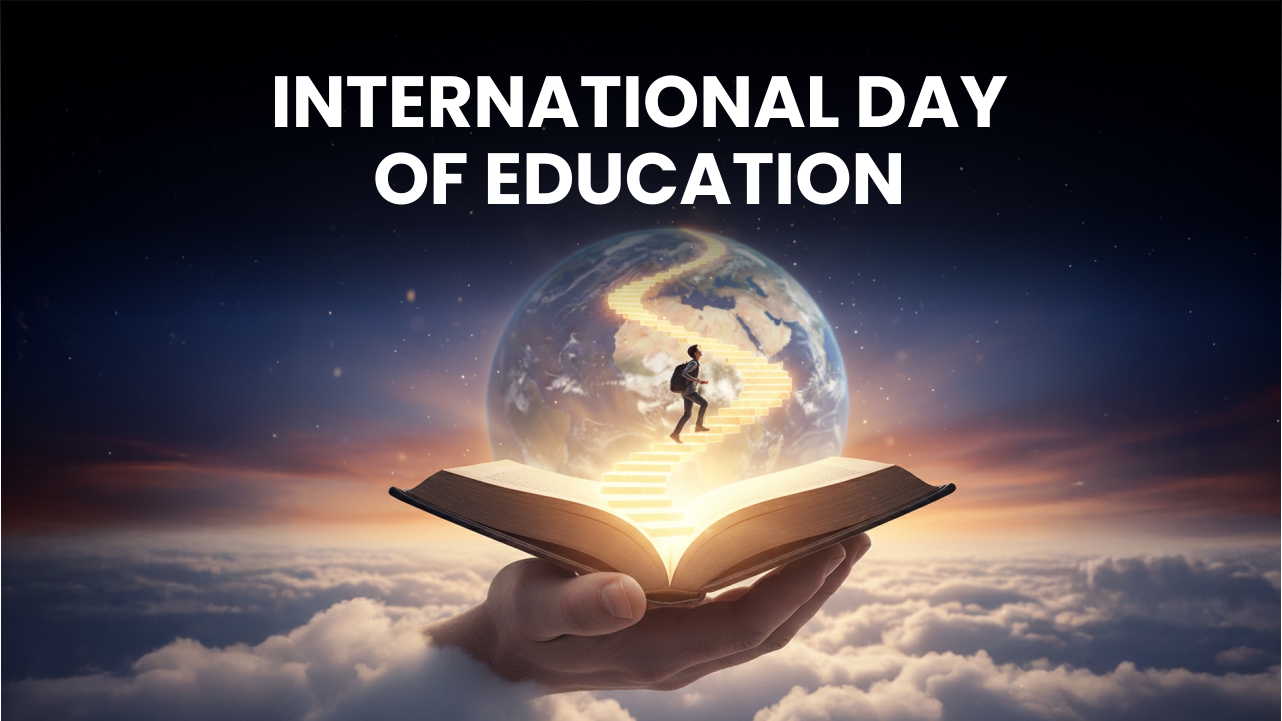
Observed every year on 24 January, the International Day of Education underscores education as a fundamental human right and a cornerstone of sustainable development. For families across India, the day highlights how learning goes beyond examinations and instead plays a vital role in shaping values, resilience and lifelong capability in children across all age groups.
1. The Origins and Aim of the International Day of Education
- The day was proclaimed by the United Nations General Assembly (UNGA) through Resolution 73/25, adopted by consensus on 3 December 2018.
- The initiative was spearheaded by Nigeria, co-authored by 58 UN Member States, and introduced by E. Tijjani Muhammad-Bande, then Nigeria’s Permanent Representative to the UN (United Nations).
- The resolution emphasised education as the most reliable path towards peace, equality and sustainable development.
- The core aim is to ensure inclusive and equitable quality education while promoting lifelong learning opportunities for all.
2. Why January 24th Was Chosen
- Unlike other UN observances linked to historic anniversaries, January 24th was selected as a symbolic fresh start to the year.
- The date positions education as the first global priority and resolution every January.
- The timing aligned with the Global Education Meeting held in Brussels in December 2018, ensuring political commitment from education ministers, UNESCO (United Nations Educational, Scientific and Cultural Organization) and international bodies.
3. Education and the 2030 Agenda (SDG 4)
- The UN recognised that the 17 Sustainable Development Goals (SDGs) adopted in 2015 could not be achieved without focussed investment in education.
- SDG 4 specifically commits nations to providing inclusive, equitable and quality education.
- The observance highlights the urgent need to address the reality of 250+ million children globally still out of school.
4. Education as the Foundation of Child Development
- UNESCO research shows that consistent education strengthens cognitive development, emotional regulation and problem-solving skills.
- Holistic learning environments balance academics with social, ethical and emotional growth.
- Aligned with these findings, studies confirm that when parental involvement remains supportive rather than pressurising, it reinforces emotional security, enhances motivation and builds confidence, allowing children to fully benefit from well-rounded educational environments.
5. Bridging Learning Gaps Through Inclusive Education
- The Global Education Monitoring Report stresses inclusive education for diverse learning needs.
- Flexible pedagogy, emotional support and early intervention reduce academic stress and disengagement.
- Closing learning gaps ensures equal opportunities across socio-economic backgrounds.
6. The Science Behind Effective Learning
- Educational psychology highlights the role of structured routines and positive reinforcement in memory retention.
- Neuroscience studies show that active learning outperforms rote memorisation for long-term understanding.
- These findings reinforce the importance of quality education systems over performance-driven models.
7. Education and the Future of Society
- Economists and sociologists agree that educated societies adapt better to technological change.
- Education cultivates critical thinking, ethical judgement and empathy.
- The first International Day of Education was celebrated on 24 January 2019, and 2026 marks its eighth observance, often focusing on themes such as digital literacy and AI in classrooms.
The International Day of Education reinforces a universal truth: education shapes minds, futures and societies. When learning is meaningful, inclusive and supported, education becomes a lifelong source of confidence, purpose and possibility.
International Day of Education
Education is truly a cornerstone for sustainable development. It’s great to see how the post emphasizes the importance of making learning accessible to all children, regardless of background. The more inclusive education is, the better our future will be.