
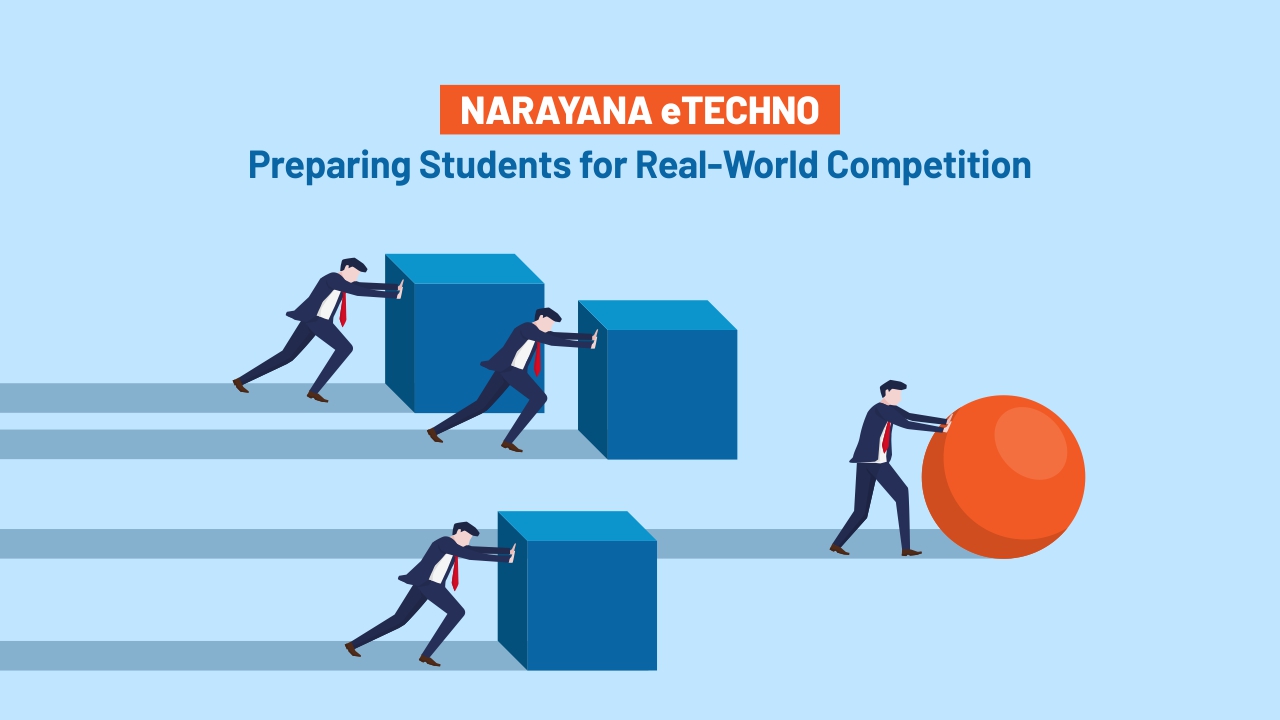
In the transition from childhood to adolescence lies a phase full of promise, complexity and opportunity. For students aged 11 to 16 (Classes 6 to 10), this period is when dreams evolve into goals and the competitive world demands not just knowledge but also resilience, creativity and adaptability.
Research published in the Proceedings of the National Academy of Sciences (PNAS) shows that middle school interventions improving students’ outlook on challenges led to higher attendance, fewer failing grades, and stronger perseverance. Similarly, a large‐scale review in Frontiers in Psychology found that career readiness programmes in middle schools significantly enhanced decision-making and adaptability, proving that the middle (Classes 6-8) and secondary (Classes 9-10) years are pivotal for preparing learners to thrive in competitive environments.
At Narayana Schools, the eTechno Programme is designed to help students not only dream and then realise those dreams but also to thrive in real-world challenges and competitive environments.
Why Classes 6 to 10 Are Pivotal?
The years from 11 to 16 mark a major shift in how children learn and grow. Jean Piaget’s Theory of Cognitive Development identifies this as the Formal Operational Stage, when students begin thinking abstractly, reasoning critically, and solving complex problems. At the same time, Erik Erikson’s Psychosocial Theory highlights this period as crucial for building identity and confidence. Together, these milestones make Classes 6 to 10 the true foundation for future success.
The eTechno Programme: Dream Big, Compete Boldly
At Narayana Schools, Classes 6 to 10 are not only stepping stones but foundations for competence, confidence and competitive spirit. The eTechno Programme unlocks a child’s full potential by blending academic excellence with holistic growth. By fostering critical thinking, creativity and resilience, students are prepared not only for competitive exams but also for future challenges and real life situations.
Our Methodology
a. Integrated Curriculum: Study materials are carefully designed using the best elements of Central Board of Secondary Education (CBSE), Indian Certificate of Secondary Education (ICSE), International General Certificate of Secondary Education (IGCSE) and International Baccalaureate (IB). This ensures strong conceptual clarity and a well-rounded learning approach.
b. The 4Cs Framework
- Common Teaching: Unified pedagogy combining theory and practice.
- Common Microschedule: Daily and monthly plans keep students organised and disciplined.
- Common Examination: Assessments mimic competitive exam formats and remain consistent across branches.
- Common Analysis: Reports are released within three days to encourage timely feedback and healthy competition, while also showing each student’s relative stance to help them understand where they stand in the competition.
c. Personalised Error Analysis: Personalised Error Analysis transforms every test into a learning roadmap by generating detailed, question-wise and subject-wise error lists. These reports enable quick reflection, targeted remediation and customised microschedules that prevent repeated mistakes. Integrated with Narayana Schools’ digital platforms, this system ensures timely feedback, focused practice and measurable improvement, driving students towards a true zero-error mindset.
d. Olympiad Programme: A specialised Olympiad preparation track builds problem solving, logical reasoning and innovation skills. Students gain exposure to national and international competitions, preparing them to stand out on a global platform.
e. Learner Support Programme: Learning gaps are identified early through diagnostic assessments and regular micro-tests, helping us spot challenges in concepts, subjects or skills. These are then addressed through personalised mentoring and targeted lesson plans, ensuring every child gets the support they need to excel.
f. Pedagogy: At Narayana Schools, we follow the Panchpadi model from the National Curriculum Framework (NCF) 2023, a five-step learning process while tailoring it based on middle and secondary students (Classes 6–10) requirements:
| Aditi (Introduction) |
Teachers link new topics to prior knowledge.
For example, while introducing algebra in Class 6, concepts are connected to familiar arithmetic patterns. |
| Bodh (Conceptual Understanding) |
Students deepen understanding through active engagement.
For example, in Class 8 science, learners explore the concept of photosynthesis by conducting experiments and discussing its role in ecosystems. |
| Abhyas (Practice) |
Concepts are reinforced through structured practice.
For example, in Class 9 mathematics, group problem-solving sessions strengthen geometry skills with peer collaboration. |
| Prayog (Application) |
Knowledge is applied to real-life situations.
For example, Class 10 students might design a budget plan in economics, applying percentages and ratios to everyday scenarios. |
| Prasar (Expansion) |
Students expand learning through peer teaching and presentations.
For example, in Class 7 history, learners prepare group presentations on ancient civilisations, sharing insights and broadening perspectives. |
Alongside this, we integrate National Education Policy (NEP) 2020 pedagogies:
| Flipped Classroom Pedagogy |
Students review lessons independently first, followed by activity-based learning in class to encourage better understanding and teamwork. For example, in Class 9, students watch a video on chemical bonding at home, then use classroom time to model molecules and discuss their properties. |
| Art Integrated Learning Pedagogy | Using arts to make learning enjoyable while building creativity and cross-curricular connections.
For example, in Class 6 geography, students create maps with art techniques like collage or painting, making learning more visual and engaging. |
| Project-Based Learning Pedagogy | Where students collaborate, reflect and apply knowledge in real contexts.
For example, In Class 8, learners collaborate on a renewable energy project, building small working models of wind turbines or solar cookers. |
| Cutting-Edge Pedagogy | Integrating technology with problem-solving approaches to effectively cater to the diverse needs of every learner.
For example, in Class 10, coding tasks and simulations are used in computer science, enhancing problem-solving with real-world technological applications. |
| Critical Pedagogical Approach | Encouraging questioning, inquiry and self-directed discovery to foster deeper understanding and independent thinking.
For example, in Class 7 social science, students debate the pros and cons of urbanisation, encouraging inquiry and independent thinking. |
| Gratitude as a Pedagogy | Instilling thankfulness, reflection and wellbeing into classroom culture to nurture positive values and holistic growth.
For example, In Class 6 English, reflective journaling activities encourage students to write weekly gratitude notes, promoting positivity and emotional well-being. |
Academics and Beyond
At Narayana Schools’ eTechno Programme, education extends far beyond the classroom, offering students diverse opportunities to apply their knowledge, explore their passions and grow into well-rounded individuals.
a. National Space Society (NSS) Space Settlement Contest: Organised by NASA (National Aeronautics and Space Administration), this global contest inspires students to design innovative solutions for human settlement in space. By working on futuristic concepts that harness space resources for civilisation, learners gain exposure to cutting-edge science and creative problem-solving.
b. Co-scholastic Activities: A wide range of clubs encourages students to discover their interests while building interdisciplinary connections between academics and real life. From the Community Service Club to the STEM (Science, Technology, Engineering, and Mathematics) Club and from Cultural and Eco Clubs to the Young Entrepreneur Club, every learner finds a platform to develop confidence, leadership and collaboration.
c. Extracurricular Competitions and Events: Carefully curated competitions provide students with opportunities to sharpen their skills and expand their perspectives. Events such as the Annual Spell Bee, Master Orator Contest, Model United Nations (MUN), Quiz Whizz Competition and Safalta Ka Rasta foster global awareness, public speaking, critical thinking and teamwork, shaping tomorrow’s leaders.
d. nSports: Our structured, age-appropriate physical education programme balances mental and physical development. By nurturing sporting excellence alongside values such as teamwork, discipline and fair play, students build both resilience and character through a range of sporting opportunities.
DISHA – Mental Wellness Programme
At Narayana, we believe that true education extends beyond academics. Our DISHA Programme is dedicated to promoting holistic well-being by offering mental and emotional support to students, parents, teachers and employees. Through counselling, guidance and wellness initiatives, DISHA provides a safe, empathetic space to address challenges, build resilience and foster a balanced life. The programme is supported by a team of 130+ counsellors and psychologists, reaching over 13.5 lakh students in the last year alone.
DISHA Provides:
- Group Assistance Programme: Awareness sessions to normalise mental health conversations and build resilience.
- Personal Assistance Programme: One-on-one sessions in a safe, confidential space for coping and growth.
- Parent Assistance Programme: Guidance to help parents support children’s emotional needs.
Building Strong Parent–School Connections
- Adoption Calling: Each group of up to 30 students is assigned a dedicated teacher who tracks their overall progress by coordinating with subject teachers and maintaining a complete learning profile.
Every 15 days, the teacher connects with parents through scheduled calls to share updates on academics, classroom experiences and growth, while also addressing parent feedback. This structured system nurtures trust, transparency and holistic development. - nConnect: Our app keeps parents actively involved with real-time progress reports, classroom updates, and seamless communication at their fingertips.
Tech-enabled learning
Tech-enabled learning at eTechno combines smart classroom tools with AI-driven tutoring to make lessons richer and more accessible. The nLearn platform now includes ASTRA (Advanced Student Tutoring & Resource Assistant), an AI assistant that offers instant doubt resolution and personalised practice, while the platform delivers interactive modules, eBooks and exam simulations. These simulations are designed through exam templates that mirror the structure of original Board examinations and Joint Entrance Examination (JEE), providing a range of tests designed to evaluate every aspect of the curriculum, from conceptual clarity to critical thinking, problem-solving ability and competitive edge.
From Classes 6 to 10, smartboards play a central role in making lessons interactive and engaging. Teachers use them to display e-books, multimedia lessons, simulations and real-time problem-solving exercises, allowing abstract concepts to be visualised with clarity. These boards also encourage collaboration through group activities, quizzes and brainstorming sessions, helping students stay actively involved in class. By blending visual, auditory and kinaesthetic (experiential) learning methods, smartboards ensure better comprehension, focus and retention.
The eTechno Programme aims to prepare students not just to learn but to compete, thrive and lead. For Classes 6 to 10, this means equipping them with clarity and critical thinking alongside a strong foundation, relevant skills and the right mindset to make their dreams real in a competitive world. We empower every student to step into challenges with confidence and to turn every dream into an achievement, because at Narayana Schools, your dreams are our dreams.
I liked the initiative. I truly believe that at Narayana students gets the best of the knowledge.
I like this post, enjoyed this one appreciate it for putting up.
thank you for sharing with us, I think this website truly stands out : D.