
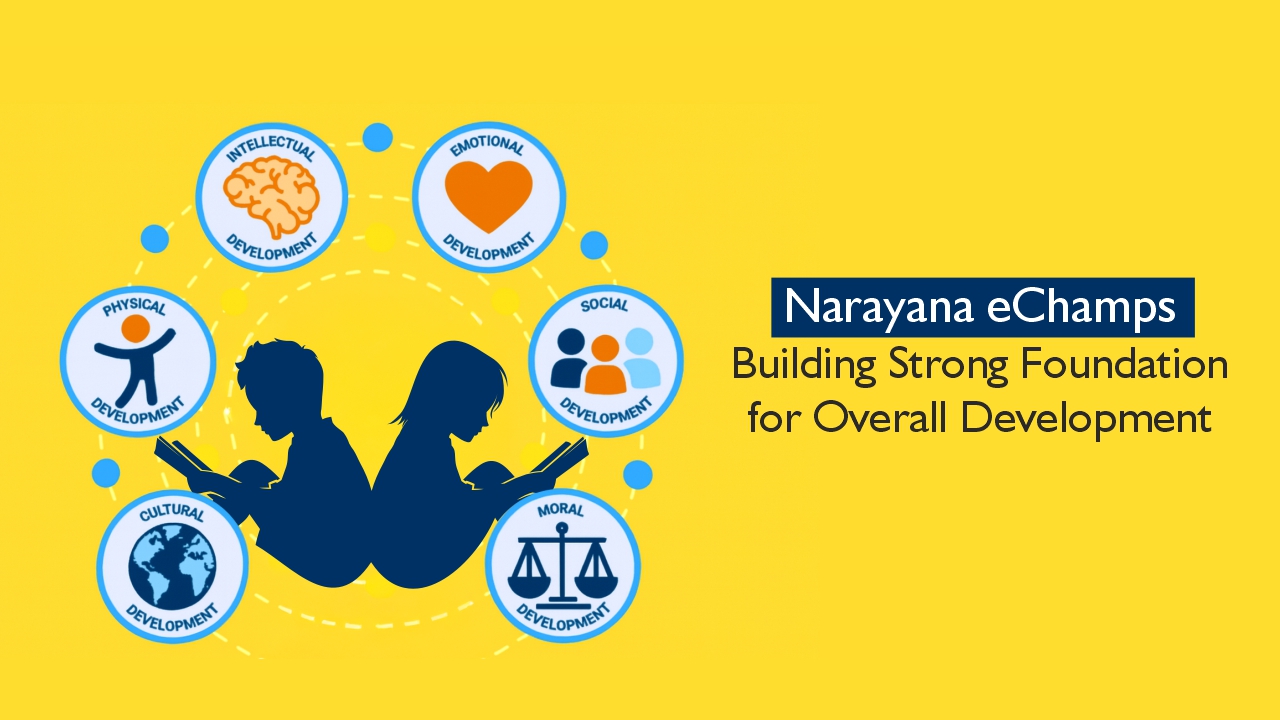
In every child’s heart lies a dream of discovery, growth and achievement. At Narayana Schools, our belief is that primary education (Classes 1-5, ages 6-11) is the critical ground where that dream begins to take shape. According to the National Education Policy (NEP) 2020, primary school years are foundational to developing literacy, numeracy and a wide spectrum of essential skills. Our eChamps Programme lays a strong foundation through an age-appropriate curriculum specifically tailored for primary years, blending academic learning with holistic development to nurture confident, creative and curious learners.
Research such as the Impact of Primary Schooling Expansion under India’s Sarva Shiksha Abhiyan shows that expanding primary schooling correlates with improved adult educational attainment, literacy and health outcomes. Also, studies of learning poverty reveal that many children in late primary ages lag in reading and numeracy, making early interventions crucial.
At Narayana Schools, we view primary education as the foundation on which children not only learn but also dream and eventually realise those dreams. Through eChamps, children build essential skills step by step, ensuring that their early years are meaningful, engaging and future-ready. It is during these years that confidence blossoms, social and emotional maturity develops, and children learn not just what to learn but how to learn.
Our Unique Approach to Learning
The eChamps Programme emphasises holistic development by blending academic excellence with social, emotional, and communication skills. We ensure that every child’s journey is filled with curiosity, creativity, care and confidence, in a safe, positive and nurturing environment.
Key Areas of Development
a. Communication Skills: Enhancing listening, speaking, reading, and writing abilities.
b. Social Skills: Fostering respect, interaction, and proper etiquette in group settings.
c. Emotional Skills: Guiding children to value participation over competition and to embrace both achievements and setbacks as part of their growth journey.
Our Methodology
- Integrated Curriculum: Workbooks and study materials are meticulously designed drawing from the best elements of Central Board of Secondary Education (CBSE), Indian Certificate of Secondary Education (ICSE), International General Certificate of Secondary Education (IGCSE) and International Baccalaureate (IB) boards to ensure deeper conceptual understanding and a well-rounded learning approach.
- 4Cs: We maintain Common Teaching, Common Micro Schedule, Common Examination and Common Analysis to ensure consistency and clarity across classes.
- Conceptual Understanding: For Classes 1–2, we use activity-based learning that engages children through interactive tasks, games and hands-on activities, making foundational concepts fun and easy to grasp. For Classes 3–5, experiential learning deepens understanding by connecting lessons with real-life examples, experiments and practical applications, ensuring lasting knowledge.
- Learner Support Programme: Each child’s learning pace is respected. Gaps are identified early and addressed so every student gets guidance needed to thrive.
- Pedagogy:
We follow the Panchpadi model from National Curriculum Framework (NCF) 2023 which is a 5 step learning process, and includes –
- Aditi (Introduction): Teachers introduce new concepts by connecting them to what students already know.
- Bodh (Conceptual Understanding): Learners explore core ideas through discussions experiments and readings.
- Abhyas (Practice): Reinforcement through group work projects and exercises.
- Prayog (Application): Applying learning to real-life situations so education becomes relevant and practical.
- Prasar (Expansion): Encouraging peer learning presentations to deepen understanding and aid retention.
Alongside this we employ National Educational Policy (NEP) 2020’s pedagogies:
- Flipped Classroom Pedagogy: Students review lessons independently first, followed by activity-based learning in class to encourage better understanding and teamwork.
- Art Integrated Learning Pedagogy: Using arts to make learning enjoyable while building creativity and cross-curricular connections.
- Project-based Learning Pedagogy: Where students collaborate, reflect and apply knowledge in real contexts.
- Cutting Edge Pedagogy: Technology and problem-solving to cater to diverse learner needs.
- Critical Pedagogical Approach: Encouraging questioning, inquiry and self-directed discovery.
- Gratitude as a Pedagogy: Instilling thankfulness, reflection and wellbeing in classroom culture.
Holistic Enrichment
- nSports for eChamps: An age-appropriate and outcome-focused physical education programme promoting physical development, while nurturing confident and fit students.
- Soft Skills Development: Age-appropriate soft skills activities build self-confidence, critical thinking, listening, empathy and emotional regulation through SpellBee, Quiz Whizz, Mater Orator, NRocks (student radio station), etc.
- LEAP Classes (Learn, Empower, Apply, Practise): Handling body, mind, soul themes and regular 3B (Basic, Better, Best) English Speaking Skills Analysisfor communication improvement through debates storytelling role-plays quizzes etc.
- Co-scholastic Clubs: Health and Wellness, Heritage, Literary, Drama, STEM, Cookery and Sports Clubs offer children spaces to explore interests and realise dreams beyond academics.
Building Strong Parent-School Connections
- Adoption Calling: A dedicated teacher is assigned to a group of up to 30 students. This teacher closely monitors the overall development of every child by gathering feedback from other subject teachers and maintaining a complete learning profile.Every 15 days, the teacher personally connects with parents through a scheduled call to share insights on the child’s progress, classroom experiences and teacher observations. These conversations also provide parents with an open channel to share their feedback or concerns related to academics, hygiene, infrastructure or any other matter.
This proactive system builds a strong three-way partnership between students, parents and teachers, fostering trust, transparency and holistic growth.
- nConnect: Our app ensures transparent communication, real-time progress reports and classroom updates, helping parents stay engaged every step of the way.
Tech-enabled Learning at eChamps
Classrooms are equipped with digital whiteboards and smart boards that transform traditional teaching into an interactive and immersive experience. These tools make lessons more visual, engaging and collaborative, helping students grasp concepts with greater clarity and enthusiasm. Teachers can integrate animations, problem-solving and interactive exercises, turning every classroom session into a dynamic learning opportunity.
Beyond the classroom, our flagship app nLearn Kids extends learning into the home environment. With animated lessons, interactive stories, eBooks, playful quizzes, simulations and concept-based videos, children in Classes 1 to 5 enjoy age-appropriate digital resources that reinforce classroom teaching.
This combined approach of in-class smart learning and at-home digital exploration nurtures creativity, sharpens critical thinking, strengthens problem-solving skills and builds confident independent thinkers. By blending fun with purposeful learning, Narayana Schools lays a strong foundation for lifelong curiosity and exploration.
At Narayana eChamps, we recognise that the primary years are when students start dreaming. Our commitment is to foster a positive, inspiring and engaging environment where young learners can explore their interests, develop essential skills, build strong foundation and believe in their own potential. Through tailored resources, interactive learning and unwavering support, we aim to empower every child to dream boldly and fulfil those dreams, because at Narayana Schools, your dreams are our dreams.
I like how the post connects NEP 2020’s emphasis on foundational literacy and numeracy with the idea of nurturing curiosity and creativity. Too often primary education is seen only as a stepping stone, but framing it as the stage where lifelong learning habits are built really shifts the perspective. I’d be curious to know how the programme balances structured academics with opportunities for exploration and play, since both seem crucial at that age.
I really appreciate how the eChamps programme emphasizes both academic and holistic growth during such a crucial stage of learning. Blending technology with foundational literacy and creativity feels like a thoughtful way to prepare children for future challenges while keeping learning engaging. It’s great to see a curriculum that truly aligns with the NEP 2020 vision of nurturing curious, lifelong learners.