
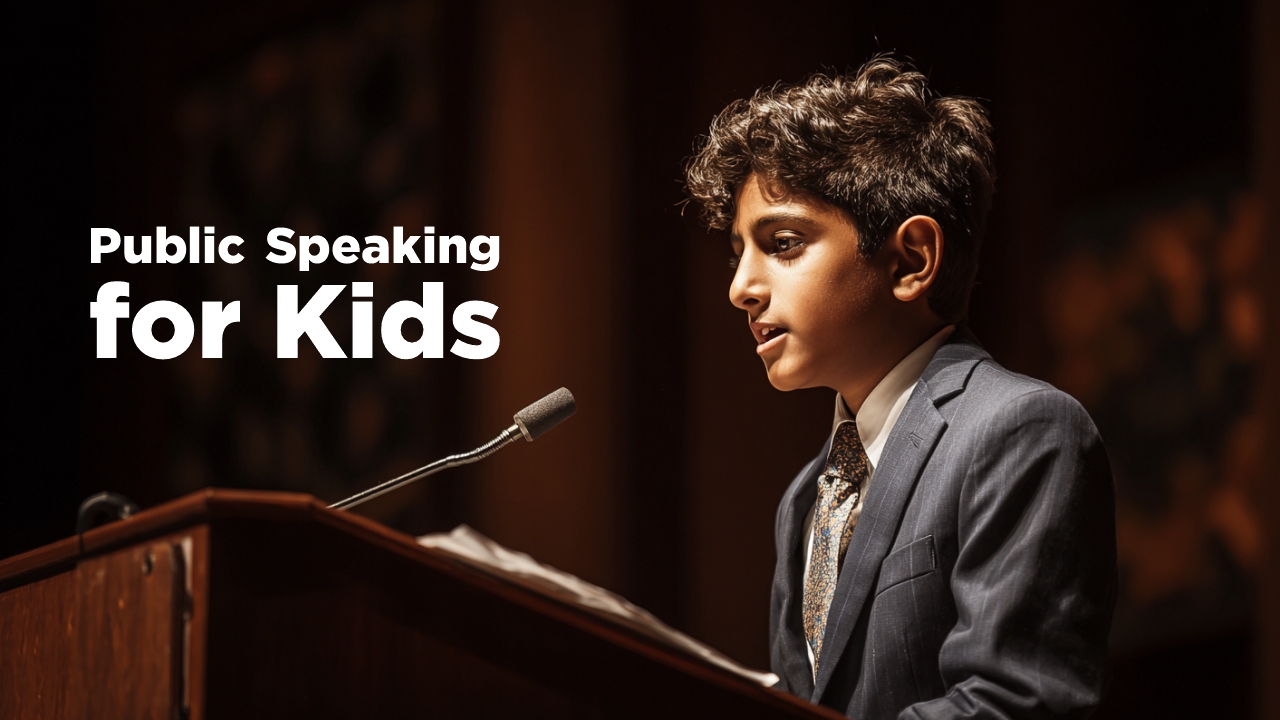
Why Public Speaking Matters in a Child’s Growth?
In a world driven by communication and collaboration, the ability to express oneself clearly is no longer optional, it is essential. Public speaking, once considered a ‘nice-to-have’ skill, is now a cornerstone of holistic education. Public speaking is more than just standing on a stage, it is about finding their voice, sharpening their thinking and expressing themselves with clarity and conviction.
The Science Behind Public Speaking in Childhood: Brain Development and Verbal Fluency
Scientific research in developmental psychology and neuroscience shows that a child’s brain is incredibly receptive to new experiences between the ages of 5 and 15. These are the years when neural pathways associated with language, memory and social interaction are most malleable. Introducing public speaking for children during this period can lead to measurable gains in confidence, cognitive flexibility and emotional intelligence.
When children practise public speaking, they engage multiple parts of the brain at once, language centres (Broca’s and Wernicke’s areas), motor functions (for gestures and expression) and the prefrontal cortex (responsible for reasoning and planning). This helps sharpen not only their communication but also their overall cognitive development.
The Real Benefits of Public Speaking for Kids
• Builds Self-Confidence: Each time a child speaks in front of an audience, big or small, their self-belief grows.
• Enhances Critical Thinking: Constructing an argument or narration encourages logical sequencing and reflection.
• Improves Listening and Empathy: Being heard makes them value others’ voices too.
• Boosts Academic Performance: Strong oral communication translates to better comprehension, writing and participation.
• Strengthens Emotional Regulation: Children learn to manage stage fright and anxiety through guided exposure.
Narayana School’s Soft Skills Programme and LEAP Edge
At Narayana Schools, we recognise that true education goes beyond textbooks. That is why we offer a robust Soft Skills Programme as an integral part of our curriculum.
Through our weekly soft skills classes, students from early grades upwards engage in roleplays, storytelling, JAM (Just A Minute), debates, news reading, elocution and mock interviews, developing real world communication skills in a safe and encouraging space.
LEAP Classes (Learn, Empower, Apply, Practise)
Our LEAP Classes form the heart of our life skills initiative. Aligned with public speaking and social development, they cover:
• Body: Safety and hygiene, articulation and positive body language.
• Mind: Respect, honesty, managing emotions and active listening.
• Soul: Gratitude, confidence and kindness.
These sessions also incorporate:
• 3B Analysis: Narayana Schools conducts the 3B (Basic, Better, Best) English Speaking Skills Analysis twice a year for students from Grades 4 to 9, aiming to assess, guide and enhance their communication abilities. Through tailored strategies like audio recordings, role plays and PEP Talks, we help students improve their spoken English with individualised support.
Weekly Activity
Every week, students take charge of NROCKS, our vibrant, in-house radio station, broadcast live through a central mic system during break hours. Here, young RJs lead the show with announcements, themes, news, fun facts, guest interviews and music. Students script, present and produce each segment, gaining invaluable hands-on experience in communication, timing, team dynamics and presentation. For many, NROCKS is their first joyful leap into the world of speaking publicly, without the pressure of a stage.
Monthly Activities
Public speaking at Narayana Schools is contextualised through monthly theme based programmes, designed to build life skills and value-based learning. These include:
• Cabinet Installation: Students take on leadership roles, fostering responsibility, collaboration and accountability within a democratic setup.
• Educational Awareness Sessions: Covering key topics such as health, hygiene, adolescence, good touch/bad touch and financial literacy, each delivered in an interactive, peer-led format.
• Nurture the Nature: Activities that deepen students’ connection with the environment, cultivating the ability to articulate sustainability issues and personal actions.
• Know Thy Country: A discovery-based module encouraging students to research and present about different Indian states, reinforcing cultural pride and public storytelling.
Annual Activities
Our structured annual events offer multitier opportunities, branch level, inter-branch and grand finales, for students to showcase their communication prowess:
• KKC (Kahaniyon Ka Caravan): A storytelling fest where students present stories with flair, creativity and emotion, an essential foundation for expressive confidence.
• MOC (Junior Master Orator Contest): Focused on clarity of speech, logical flow and persuasive oration, MOC builds the fundamentals of debate and discourse.
• Spell Bee and Quiz Whizz: These events sharpen articulation, improve pronunciation and foster a spirit of enquiry and spontaneity, key qualities for dynamic speaking.
• MUN (Model United Nations): A simulation based conference where students research, draft resolutions and engage in diplomatic dialogue, developing global awareness, logical articulation and professional communication.
What Makes Our Programme Unique?
• StageStars Curriculum: From storytelling in Grade 1 to persuasive debates in Grade 5, StageStars is Narayana Schools’ structured oratory module. Lessons progress from vocal modulation and facial expressions to persuasive techniques and audience engagement.
• Public Speaking in Weekly Schedule: Unlike standalone activities, public speaking is woven into the regular academic schedule, ensuring consistent exposure.
• Performance Showcases: Children actively participate in morning assemblies, class conclaves, talent corners and intra-school speech events which offer authentic platforms for real-world public speaking practice.
• Confidence Mapping and Feedback Loops: Teachers provide individual feedback using rubrics designed around clarity, content, confidence and connection, enabling children to reflect and improve with each performance.
• Mindfulness and Voice Control: Special activities combine breathing techniques, body posture and voice modulation, helping children manage stage fear effectively.
Long-Term Impact of Public Speaking
• Enhances critical thinking and creativity.
• Boosts collaboration and listening skills.
• Prepares students for future interviews, presentations and leadership roles.
• Aligns with NEP 2020’s emphasis on 21st-century skills.
Practical Takeaways for Parents
| What You Can Do at Home | How It Helps |
| Encourage your child to narrate a story or explain their day | Builds coherence and sequencing skills |
| Record videos of their speeches and show progress | Boosts self-awareness and confidence |
| Watch TED-Ed or kids’ speech contests together | Sparks inspiration and goal-setting |
| Use mirror practice and roleplays | Enhances articulation and body language |
At Narayana Schools, we go beyond textbooks to build thinkers, speakers and leaders of tomorrow. We offer children diverse avenues, like sports, arts, robotics and leadership platforms for holistic development. We believe confidence is not born, it is built. Backed by the science of language learning and strengthened by initiatives like LEAP and Soft Skills Training, Narayana Schools empowers students with strong communication skills, helping them grow in confidence and pursue their dreams with purpose, because your dreams are our dreams.
If I want this sessions my daughter, what I have to do? When this sessions are conducted? Please give details….
Very good initiative by the school.this will really help students to grow better personality and will encourage parents to support in such initiative by school
This is such an important topic—especially the emphasis on how public speaking supports brain development during those formative years. It’s interesting to think of public speaking not just as a performance skill, but as a tool to boost cognitive flexibility and emotional intelligence. Encouraging kids to speak up early on can truly shape how they process and communicate ideas later in life.
Good to know that you are taking so many initiatives to enhance kids skill
This good initiative, for current Zen kids very much required. Encouraging this area really helps.
Yes, I agree on the necessity of public speaking in the current era. But I cannot see the school is giving focus on the students who are weak in public speaking. They are encouraging and giving chance to students who already have good communication skills.
Hi,
To be honest, I am writing what I observed since April 2025. My daughter joined Narayana family since 3 months. I.e. since April 2025.
Since then she has stopped communicating in English completely. Also, she lost the fluency, accent and now started loosing her vocabulary day by day.
When I tried to look for the reason, I came to know that the kids communicate in Marathi or Hindi in school. And English is not used so often.
Even I experienced the same. Whenever I visited the school, whole staff uses either Marathi or Hindi.
I am not against these languages. But if we really want to improve communication of our kids, then imbibing the habit of using English as primary language is the only option. By doing this, they will be used to the language, build vocabulary, and ultimately build self confidence automatically.
Thanka
Everything is sounds good only. But there is no proper allocation of time or proper schedule for these activities and parents are not going to know unless a kid tell to their parents. If particular time is alloted for particular activity will help parents to know what is going in the school. Is Robotics is included for kids? I don’t see doing anything in it. No kit has been provided or not asked to buy then how it will work.
Please consider my words to improve quality in education.
Thankyou
English speaking thanks
Most needed for personality development of Kids