
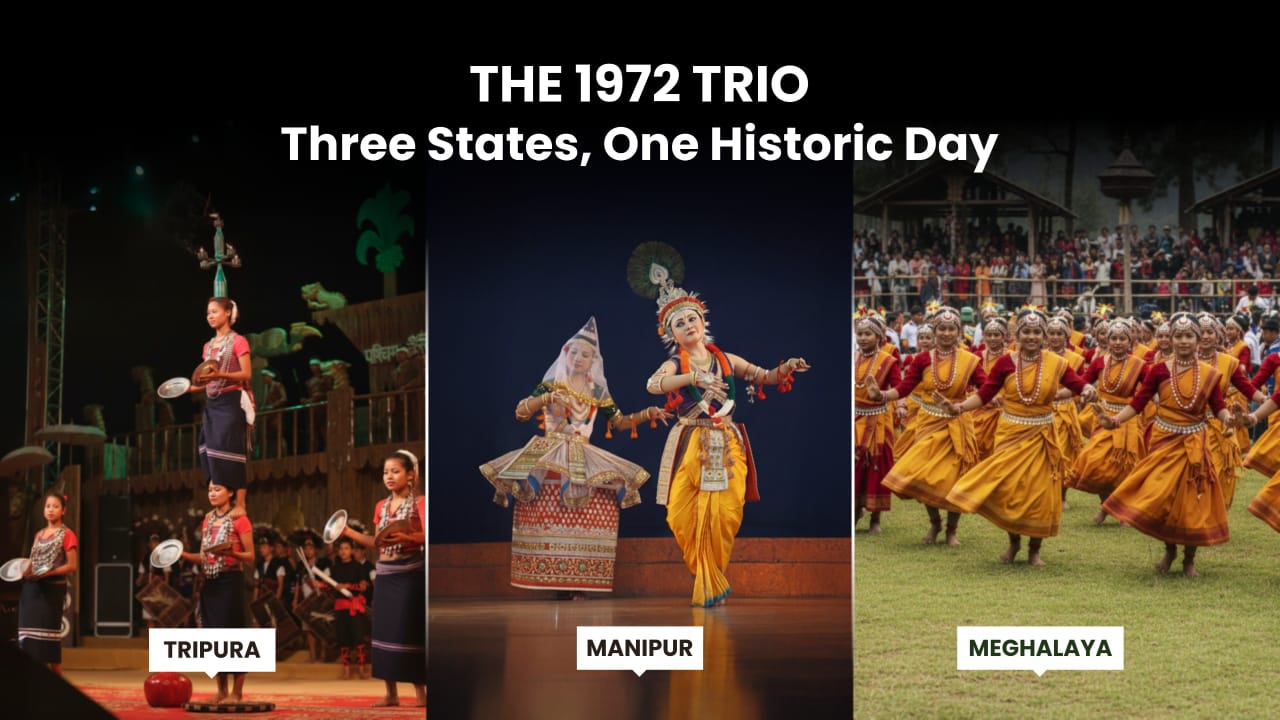
21 January, 1972, holds a special place in India’s modern history, as on this day Tripura, Manipur, and Meghalaya attained full statehood, marking a defining chapter in the story of North East India’s heritage.
Before this transition, Tripura and Manipur functioned as Union Territories, while Meghalaya was an autonomous state within Assam, arrangements that limited local administrative autonomy despite distinct cultural, linguistic and geographical identities. The move to full statehood was driven by the need to address regional aspirations, strengthen democratic representation, respond to socio-political movements seeking self-governance and ensure better governance in a strategically sensitive border region, thereby integrating these states more firmly into India’s federal framework.
For families, this milestone offers an opportunity to help children understand cultural diversity, historical identity and national integration through stories rooted in tradition, geography and lived experience.
1. Why 1972 Matters in Indian History
- The North Eastern Areas (Reorganisation) Act, 1971, which came into effect on 21 January, 1972, granted statehood to Tripura and Manipur, while Meghalaya emerged as a full-fledged state after separating from Assam.
- Political historians note that this move strengthened regional identity in India while ensuring administrative stability within the Indian Union.
- Learning about this transition helps children see how democratic systems evolve to respect cultural uniqueness and regional aspirations.
2. Tripura: A Blend of Tribal Roots and Royal Legacy
- Tripura’s history and culture reflect a rare harmony between indigenous tribal traditions and royal heritage.
- The Manikya dynasty ruled for centuries, leaving behind architectural landmarks such as the Ujjayanta Palace.
- The name Tripura is believed to originate from ancient mythology and history, with references to ‘Tripura Sundari’, a revered deity, and the Sanskrit words tri (three) and pura (cities), symbolising a land of ancient settlements and spiritual significance.
- A lesser-known but significant fact is that Tripura is home to one of India’s highest proportions of indigenous tribal population, with 19 officially recognised tribes, whose languages, festivals and ecological knowledge continue to shape the state’s identity.
- Anthropological studies highlight Tripura as a model of cultural coexistence, offering valuable lessons on social harmony in India.
3. Manipur: The Cultural Heartbeat of the East
- Manipuri heritage is deeply tied to classical dance, martial traditions and a strong sporting culture, while affirming its distinct cultural and historical identity.
- The name Manipur is derived from ancient Sanskrit texts, meaning “the jewelled land” (mani meaning jewel and pur meaning land or city), a reference found in the Mahabharata, where Manipur is mentioned as a prosperous and culturally rich kingdom.
- Manipuri dance, recognised as a classical Indian dance form, blends devotion, rhythm and storytelling, particularly through themes drawn from Vaishnavite traditions.
- A lesser-known yet significant fact is that Manipur is the birthplace of modern polo, which evolved from the traditional game Sagol Kangjei and later spread globally during the British era.
- Educational research shows that exposure to regional art forms enhances creativity and cultural empathy in children.
4. Meghalaya: Where Nature and Community Thrive Together
- The name Meghalaya is derived from Sanskrit, meaning “the abode of clouds” (megha meaning cloud and alaya meaning home), reflecting the region’s high-altitude geography and frequent cloud cover.
- Meghalaya’s culture and history are shaped by a matrilineal social system, where lineage and inheritance pass through the mother, offering a rare and meaningful example of gender-balanced social organisation in India.
- Environmental studies often cite living root bridges, grown organically from the roots of rubber fig trees, as remarkable examples of sustainable engineering and long-term ecological wisdom.
- A lesser-known but significant fact is that Meghalaya is home to Mawsynram, recognised as one of the wettest places on Earth, making it a vital natural laboratory for climate and rainfall studies.
- These traditions and natural practices introduce children to environmental stewardship, resilience and community-based living rooted in harmony with nature.
5. The People, Land and Living Traditions of the 1972 Trio
- Tripura, Manipur and Meghalaya are home to diverse indigenous communities whose lifestyles are closely shaped by forests, hills and rivers, making geography central to daily life.
- Tripura is inhabited by several tribal groups such as the Tripuri, Reang and Jamatia, with communities practising agriculture, handloom weaving and folk traditions, while Bengali and Kokborok are widely spoken.
- Manipur is home to the Meitei, Naga and Kuki tribes, known for strong community bonds, rich oral traditions and a disciplined sporting culture, with Manipuri (Meiteilon) serving as the primary language alongside many tribal dialects.
- Meghalaya is predominantly inhabited by the Khasi, Garo and Jaintia tribes, whose matrilineal social system places women at the centre of family and inheritance, shaping a distinctive way of life.
- Food across the three states reflects local geography, featuring rice-based diets, fermented ingredients, seasonal vegetables and minimal use of oil, highlighting sustainability and nutritional balance.
- Linguistic diversity thrives across the region, with Tibeto-Burman and Austroasiatic language families adding to India’s cultural richness.
- Hills, dense forests, high rainfall and river valleys influence housing, clothing and livelihoods, creating cultures that value harmony with nature.
- These elements make the 1972 Trio unique, offering children meaningful insights into how people adapt to land, climate and community values, and why India’s North East remains one of the country’s richest cultural landscapes.
6. The Shared Spirit of the 1972 Trio
- Despite distinct languages and customs, the three states share values of resilience, community and respect for nature.
- Sociological research emphasises that learning about diverse regions fosters national integration and inclusivity from an early age.
- Stories from the North East help broaden perspectives beyond textbooks.
7. Making Learning Relatable for Children
- Mapping exercises, folk stories and regional food discussions bring Indian cultural diversity into everyday conversations.
- Linking history with festivals, music and landscapes makes learning engaging and memorable.
The 1972 Trio stands as a reminder that India’s strength lies in its diversity, where multiple histories come together to shape a shared future. Understanding the heritage, history and heart of Tripura, Manipur and Meghalaya helps children grow with respect, curiosity and pride in the many stories that together form the nation.