
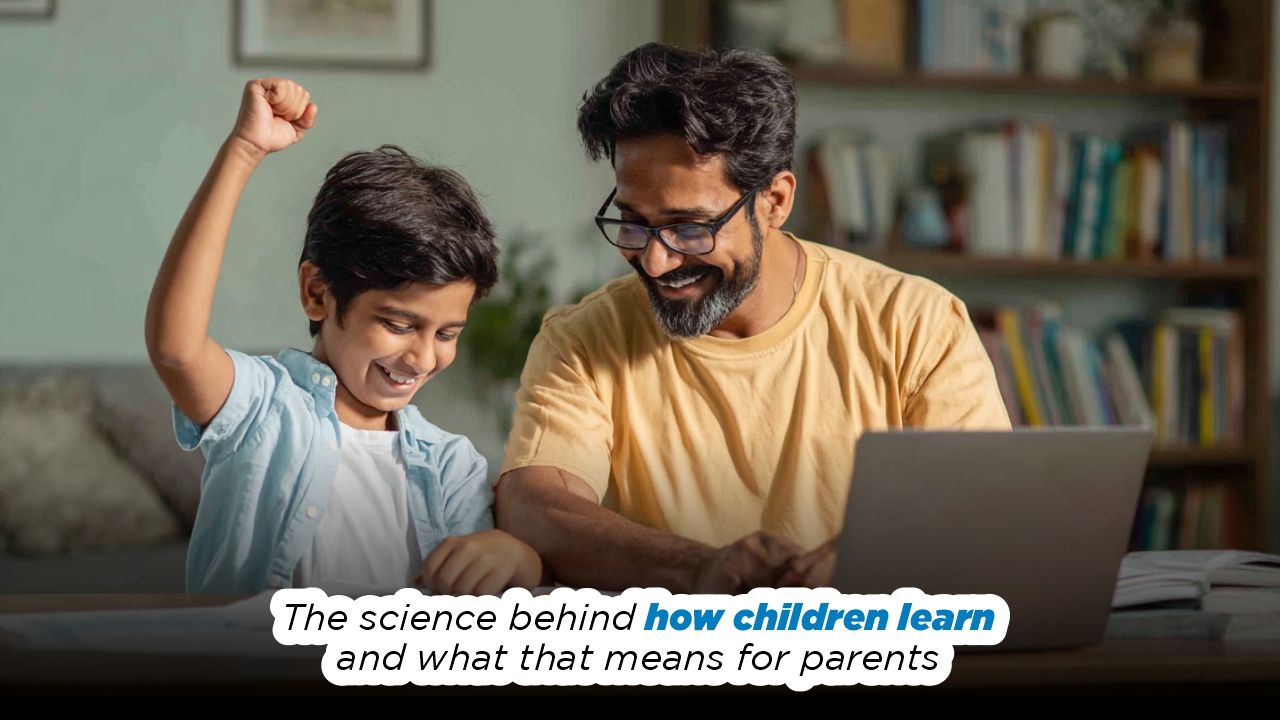
Understanding how children learn is not just a matter of academic excellence but a practical and vital insight for shaping their future. Cognitive science, educational psychology, and developmental neuroscience have converged to provide clear evidence that learning is deeply tied to how the brain grows, processes information, and makes sense of the world. For parents of school-age children in India, understanding this science can make a significant difference in guiding children effectively.
How the Brain Learns
From infancy to adolescence, the brain goes through several crucial developmental stages. According to the Harvard University Center on the Developing Child, 90% of a child’s brain development happens before age five. However, significant cognitive growth continues throughout the school years with the prefrontal cortex responsible for planning, decision making and impulse control, maturing well into the early twenties.
Neuroplasticity, the brain’s ability to reorganise itself by forming new neural connections, is especially strong in childhood. This means that the more meaningful experiences a child has through play, exploration, conversation and problem-solving, the more robust their cognitive foundation becomes.
Learning Is Not One Size Fits All
Studies from the National Institute of Mental Health and Neurosciences (NIMHANS) in India highlight that children exhibit a wide variety of learning styles: visual (learning through images and spatial understanding), auditory (learning through listening and verbal cues), kinaesthetic (learning through movement and hands-on activities) or a combination. Recognising these preferences allows parents and educators to tailor learning strategies for children accordingly.
For example, a child who learns best visually might benefit more from diagrams and videos, while a kinaesthetic learner might thrive through role-play or building models. Rather than forcing uniform methods, embracing these differences can increase both understanding and retention.
The Role of Sleep and Emotional Safety
Modern research increasingly emphasises the importance of emotional well-being and adequate sleep for students. According to a 2022 study by the All India Institute of Medical Sciences (AIIMS), children who receive 8–10 hours of consistent sleep perform better in cognitive tasks and demonstrate improved emotional regulation.
Stress, on the other hand, negatively affects memory retention and concentration. Positive reinforcement, a calm home environment and empathy significantly enhance learning efficacy. Emotional security fosters the psychological freedom needed to explore, fail and try again, a key aspect of deep learning.
Curiosity: The Hidden Engine of Learning
One of the most underestimated elements of learning is curiosity. A study conducted by the University of California, Davis found that when curiosity is piqued, the brain releases dopamine, a neurotransmitter associated with motivation and memory. This enhances the retention of both relevant and even unrelated information learned during that period.
Parents can nurture curiosity by encouraging questions, entertaining ‘what if’ scenarios and allowing children to lead conversations or experiments. Unlike rote memorisation, curiosity-driven learning creates lasting knowledge and deeper engagement.
Interactive Parent-Child Activity Ideas to Boost Learning
Engaging in hands-on, collaborative activities not only strengthens parent-child bonding but also stimulates different areas of the brain. Here are a few effective brain boosting activities for children rooted in neuroscience:
- Kitchen Science: Simple experiments like vinegar and baking soda reactions or making invisible ink teach scientific concepts through fun.
- Storytelling with a Twist: Ask children to invent alternate endings to familiar stories. This boosts creativity, memory and narrative thinking.
- Memory Games: Play card matching or ‘what’s missing on the tray’ games to improve working memory and attention span.
- Gardening Projects: Planting and tracking growth teaches patience, responsibility and scientific observation.
- Math in Daily Life: Include children in measuring ingredients, handling currency or comparing prices during shopping trips to apply maths practically.
Practical Takeaways for Parents
| Strategy | When to Use | Example |
| Stimulate curiosity | Daily during meals or play | What do you think will happen if…? |
| Narrate everyday tasks | During chores or walks | Ask them to remind you to buy vegetables/grocery post work or to alert you when the milk is about to boil over. |
| Ensure consistent sleep | Night routine | Fixed bedtime, bedtime reading |
| Schedule breaks | After 45–60 mins study | Playtime |
| Encourage movement learning | While studying or revising | Teach them concepts in a practical and relatable way, for example, demonstrate the Tyndall Effect by showing how sunlight reveals dust particles in the air. |
| Discuss emotions and learning | Family time/Dinner time | How was your day today? Were classes hard today? Did you make new friends today? Did something upset you? |
What This Means for Parents
Learning strategies for children, how the brain learns and child development and education are not abstract concepts, they are blueprints for action. Learning is not about piling information, it is about creating meaningful connections. By understanding the neurological and emotional processes behind learning, parents can create environments that are rich in exploration, supportive in failure and adaptive to the child’s individuality.
Today’s academic world often demands quick results, but science shows that true learning thrives in environments where children feel secure, curious and supported. The goal is not just academic performance, but nurturing thinkers, problem solvers and lifelong learners.
At Narayana Schools, we recognise the complex journey of learning and parenting. That is why we have created Disha, a dedicated programme where students and parents can reach out for expert help, guidance and support, whether it is academic queries, emotional well-being or learning strategies based on developmental science.
Disha is our way of standing beside you as a partner in your child’s growth ensuring that no question is too small, and no challenge too big.
We believe every spark of curiosity, every step forward and every moment of learning brings your child one step closer to their dream and we are here to help children not only dream but realise them, because at Narayana Schools, your dreams are our dreams.
I appreciate how this post highlights the ongoing nature of brain development, even beyond those early years. It’s a great reminder for parents that staying engaged with how their children learn is a long-term, evolving process.
Good
Thanks a lot for helping parents understand the child brain growth and development.Articles like these help us guide our children better and also is serves as a checklist in the way we handle our kids.Thank you once again.
This is such an insightful piece—especially the reminder that 90% of brain development happens before age five. It really highlights how early experiences, like play and interaction, shape how children process and retain information later on. I’d love to see more discussion on how parents can balance structured learning with curiosity-driven exploration during those formative years.