
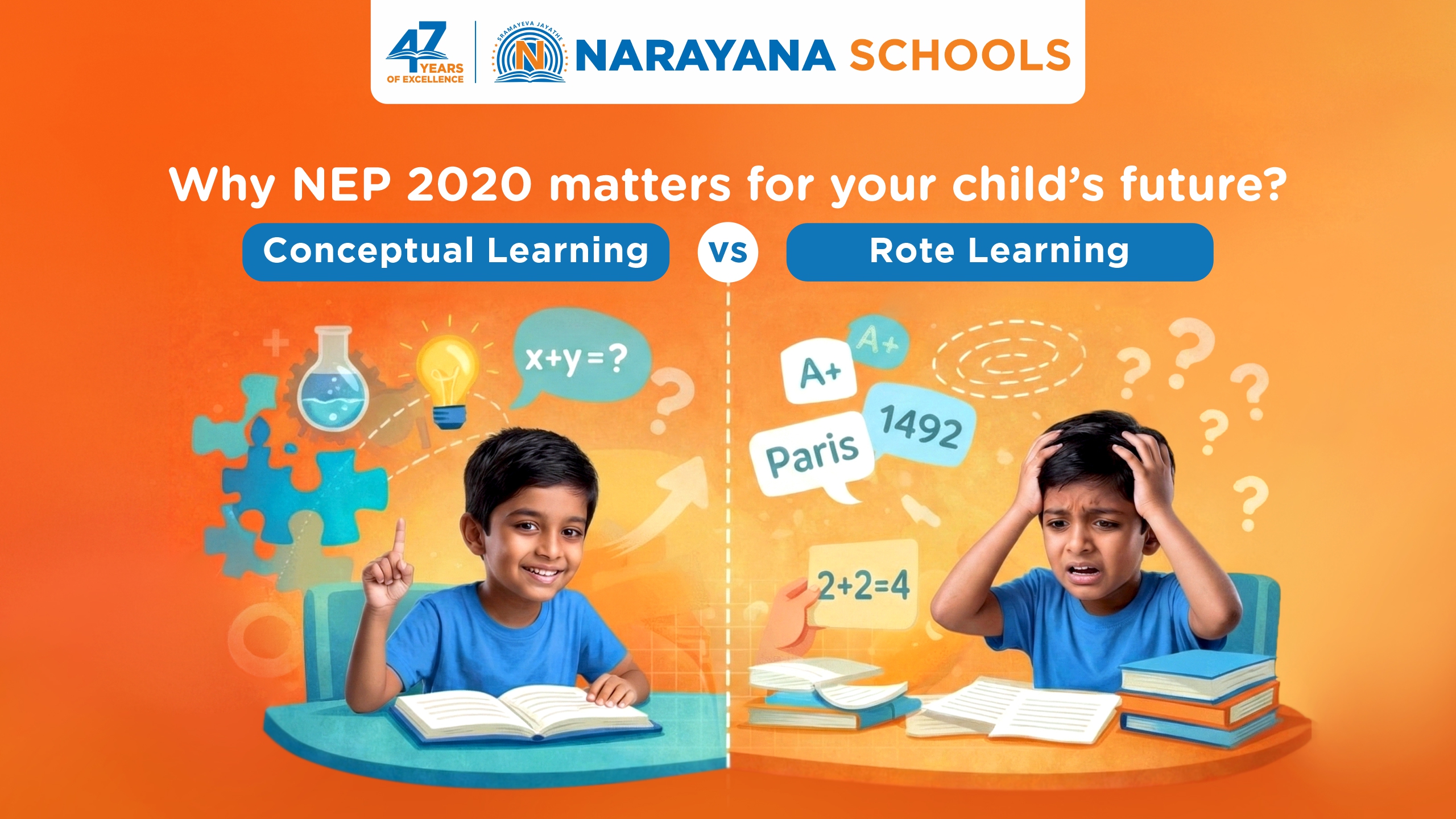
India’s education landscape witnessed a historic shift with the introduction of the National Education Policy 2020. Approved on 29 July 2020, NEP 2020 replaced the 1986 policy to align schooling with 21st-century skills, global benchmarks and cognitive science research. At its core lies a decisive move from rote learning to conceptual learning, redefining how children understand, apply and innovate knowledge.
1. Why NEP 2020 was introduced?
Educational reviews by the Government of India revealed that memorisation-heavy practices limited critical thinking and problem-solving. Global assessments such as Programme for International Student Assessment (PISA) highlighted the need for competency based evaluation. NEP 2020 signifies a shift towards holistic education in India, multidisciplinary exposure and experiential learning.
2. The science behind conceptual learning
Cognitive psychology research demonstrates that conceptual learning strengthens neural connections. Studies from Stanford University show that understanding underlying principles improves long-term retention compared to surface memorisation. Neuroscientists explain that active recall, spaced repetition and application-based tasks enhance memory consolidation far more effectively than repetitive cramming.
3. Rote learning limitations
While memorisation aids foundational recall, overdependence can restrict analytical ability. Research published in the journal Educational Psychology Review notes that students trained primarily in rote methods struggle with transfer of knowledge to unfamiliar contexts, a crucial skill in competitive examinations and modern careers.
4. What conceptual learning signifies
Under NEP 2020 reforms, curriculum design now emphasises competency-based assessment, inquiry-driven classrooms and reduced content overload. The new 5+3+3+4 structure based on age groups aligns learning stages with developmental psychology, ensuring age-appropriate cognitive progression. This reflects a broader goal: nurturing curiosity, creativity and problem-solving abilities.
5. Practical and doable approaches at home
- Encouraging explanation-based revision rather than repetitive rewriting.
- Discussing real-life applications of classroom topics.
- Supporting project-based tasks and interdisciplinary exploration.
- Creating structured study routines that prioritise understanding over speed.
These approaches align with research from the National Council of Educational Research and Training, which advocates experiential and discussion based learning for improved academic outcomes.
6. Future prospects for Children
The World Economic Forum consistently identifies critical thinking, collaboration and adaptability as essential future skills. Conceptual clarity equips learners not merely to pass examinations but to innovate, research and contribute meaningfully to society.
At Narayana Schools, the philosophy of conceptual learning is deeply embedded within the academic framework. The integrated curriculum draws upon the best practices of CBSE, ICSE, IGCSE and IB boards, creating comprehensive study materials designed to strengthen conceptual clarity, analytical thinking and deeper subject understanding.
This spirit of inquiry is nurtured progressively across every stage of learning. An activity-based learning approach in Classes 1–2 encourages exploration, curiosity and active engagement with concepts. In Classes 3–5, the eChamps programme introduces experiential learning to lay a strong foundation, enabling students to connect classroom knowledge with real-world observations and practical understanding.
From Classes 6–10 under the eTechno programme and beyond, the focus shifts to building strong conceptual clarity through structured learning centred on Concepts, Definitions and Formulae (CDF). Supported by the Panchpadi learning process, NEP-aligned teaching methodologies and decades of academic expertise, this stage focuses on preparing students for the competitive world ahead.
Beyond classroom learning, co-scholastic platforms for Grades 6–10 provide opportunities for students to apply knowledge through hands-on projects, working models and presentations. Through four dynamic clubs, Pixel Palette (Digital Creativity), Synergy X (STEM and Aerospace), Idea Vault (Entrepreneurship and Innovation), and Global Vox (Public Discourse and Diplomacy), learners explore real-world challenges, design innovative solutions and present ideas with confidence and collaboration.
Such an ecosystem ensures that conceptual learning evolves into creativity, critical thinking and future readiness, empowering students to transform knowledge into meaningful achievement.
In essence, Conceptual Learning vs Rote Learning is not a debate of memory versus understanding, it is about preparing children for a rapidly evolving world. Aligning with the vision of NEP 2020, Narayana Schools signal a strong commitment to an education system that values reasoning over repetition. This approach focuses on nurturing confident, capable and future-ready citizens who not only dream boldly but also pursue and fulfil those dreams fearlessly, because at Narayana Schools, your dreams are our dreams.