
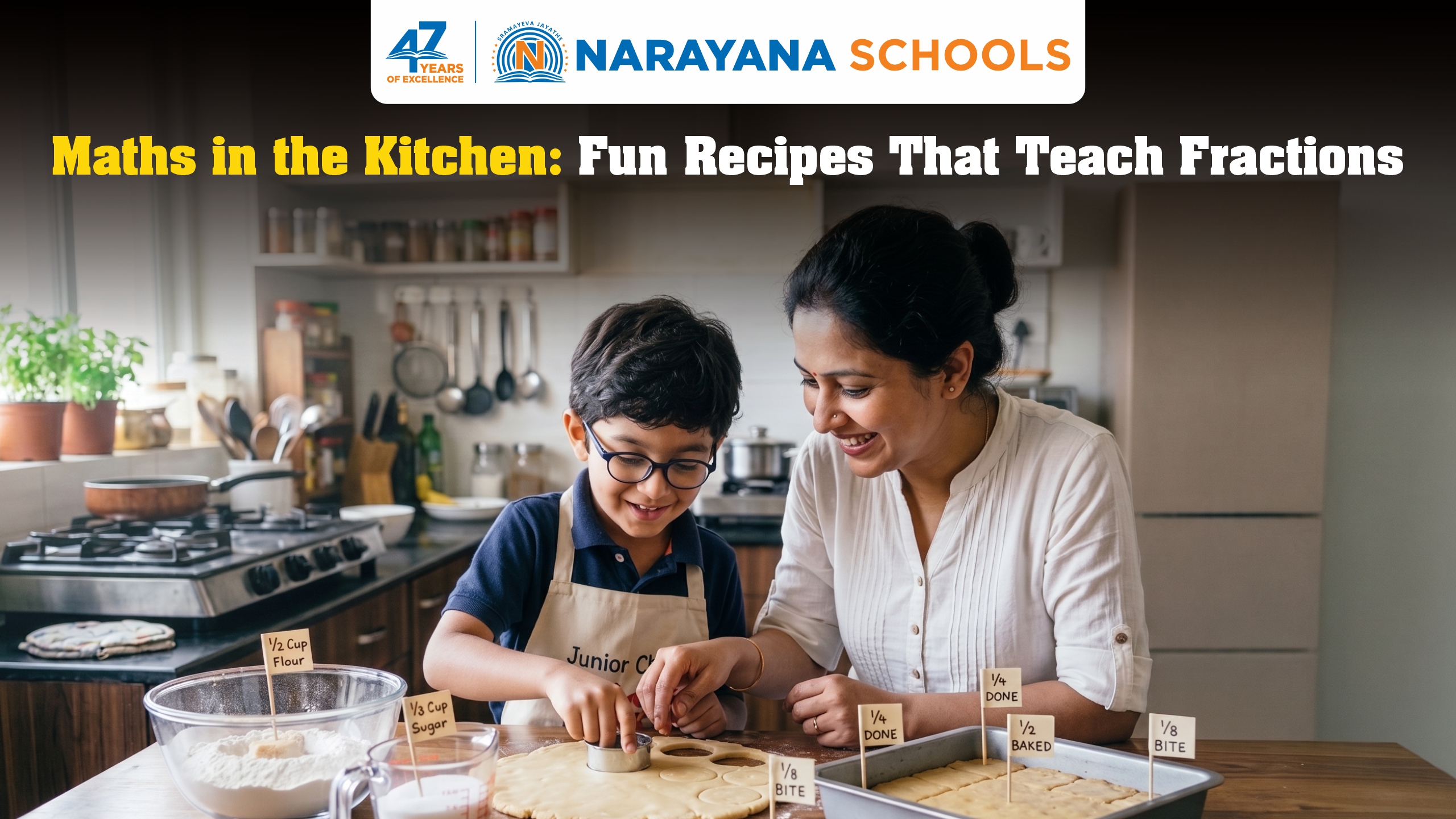
In many households, the kitchen is more than a place for cooking, it is an untapped classroom. Teaching fractions through cooking is increasingly recognised by educators as an effective form of experiential learning. Research in cognitive science highlights that children grasp abstract mathematical concepts better when they are linked to tangible real world activities. This makes kitchen maths activities one of the most engaging ways to build numerical understanding.
Why learning fractions through cooking works?
- Studies show that hands-on learning improves concept retention by up to 75% compared to passive methods.
- Cooking naturally introduces fractions, like half, quarter, double, etc., making it a practical application of maths.
- According to educational research, multi-sensory activities enhance problem-solving and logical reasoning skills.
Age-wise kitchen activities to teach fractions
- Pre-Primary Level
Focus: Basic division, visual understanding.
- Fruit salad: Cutting fruits into halves and quarters introduces simple fractions visually.
- Chapati sharing: Dividing a roti into equal parts builds early division concepts.
Visual exposure helps develop early number sense and pattern recognition.
- Primary Level
Focus: Basic fractions, measurement.
- Sandwich making: Using half slices or quarter portions teaches fraction values.
- Measuring ingredients: 1 cup, ½ cup, ¼ cup measurements during baking introduce proportional thinking.
Measurement based tasks improve numerical accuracy and comprehension.
- Middle School Level
Focus: Equivalent fractions, operations.
- Recipe adjustment: Doubling or halving recipes teaches multiplication and division of fractions.
- Pizza fractions: Dividing pizzas into slices demonstrates equivalent fractions and ratios.
Applied maths strengthens analytical and reasoning abilities.
- Secondary School Level
Focus: Ratios, proportions.
- Scaling recipes: Adjusting servings introduces ratios and proportional reasoning.
- Ingredient substitution: Understanding proportions when replacing ingredients builds flexibility in thinking.
Real life applications improve higher order mathematical thinking.
- Senior Secondary and Beyond
Focus: Advanced application, precision.
- Nutritional calculations: Analysing ingredient quantities links fractions with percentages.
- Budget cooking: Planning meals within a budget integrates fractions with financial literacy.
Practical maths enhances decision making and real world problem-solving.
Making kitchen maths effective
- Encourage participation in simple cooking tasks regularly.
- Use everyday recipes to demonstrate fraction concepts naturally.
- Maintain a balance between guidance and independent exploration.
Mathematics often appears abstract in textbooks, leading to disengagement. However, when integrated into daily life, it becomes meaningful and intuitive. Research indicates that children exposed to experiential maths develop stronger conceptual clarity and confidence.
The kitchen, therefore, transforms into a dynamic learning space, where fractions are not just numbers on paper but real, visible and understandable. Such approaches ensure that learning is continuous, practical and deeply rooted in everyday experiences, preparing children for both academic success and real world challenges.
I really like the focus on multi-sensory learning in the kitchen—it’s a clever way to help younger children grasp fractions through hands-on experience. Activities like these make abstract concepts feel tangible and can really boost their confidence with numbers.
It’s a very good idea and student learn fraction topic from this activity 👍
It’s a very good idea student can learn some anything from this activity 👍
This website is good for children