
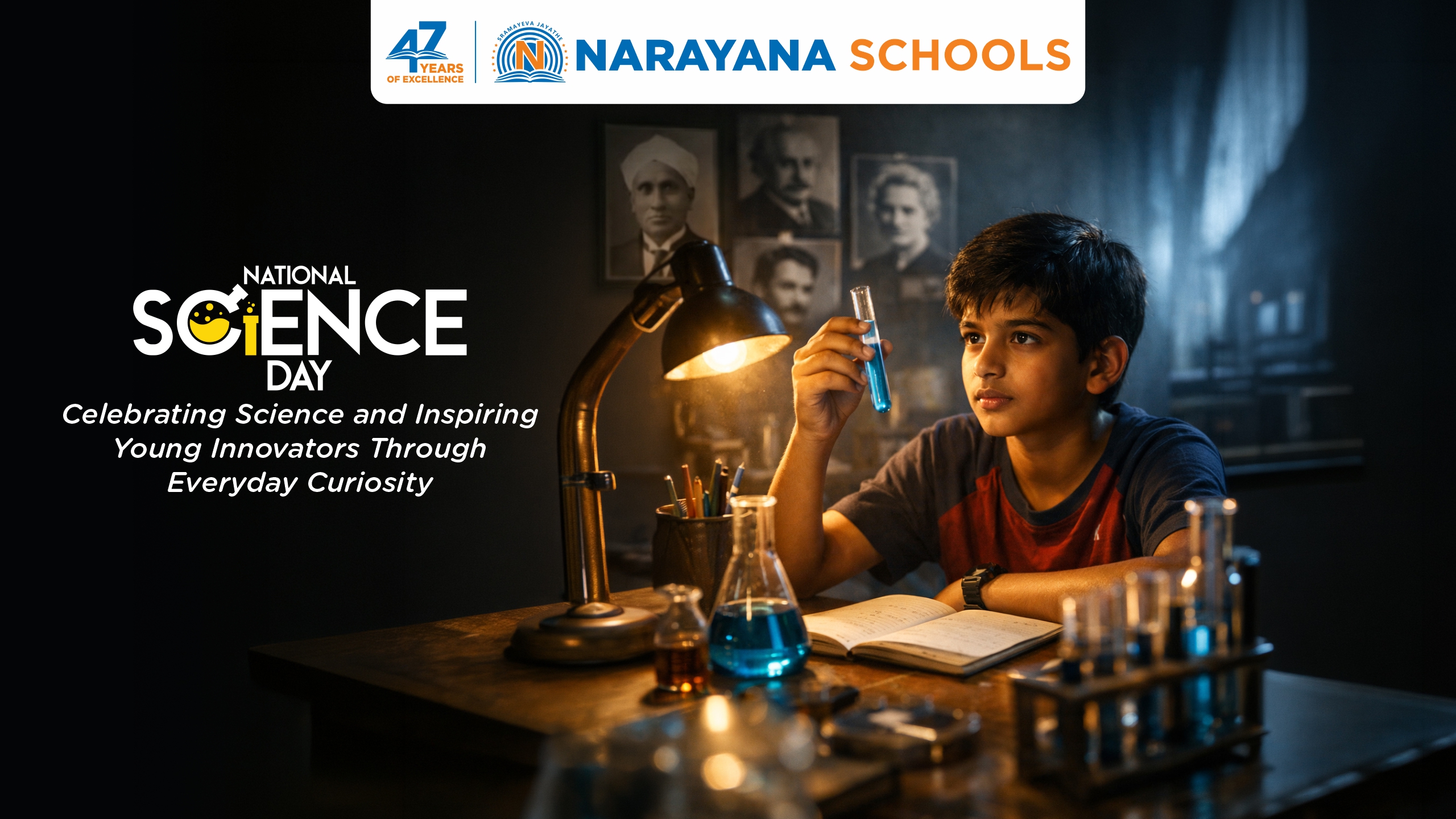
Every year on 28 February, India observes National Science Day, marking the discovery of the Raman Effect in 1928 by Nobel Laureate Sir C. V. Raman. This breakthrough in light scattering earned the Nobel Prize in Physics (1930) and placed India firmly on the global scientific map. The date signifies not merely a historic achievement, but the power of scientific temper, curiosity and research-driven progress in nation-building.
For families across India, National Science Day 2026 is more than a calendar event. It represents the importance of STEM education in India, the encouragement of inquiry-based learning and the nurturing of future-ready innovators.
1. Why 28 February matters?
The Government of India designated this date in 1986 to honour Raman’s discovery and promote science education and innovation. It signifies India’s commitment to developing a culture of research, critical thinking and evidence-based reasoning among young learners.
2. Why National Science Day is as important today?
In an era shaped by artificial intelligence, space research and biotechnology, scientific literacy is no longer optional. Reports by the World Economic Forum highlight analytical thinking and problem-solving among the most essential skills for the future workforce. Early exposure to scientific thinking strengthens adaptability and resilience.
3. What it signifies for young minds?
Research published by the National Council of Educational Research and Training (NCERT) emphasises that experiential learning improves retention and conceptual clarity. Science, when experienced through experiments and observation, shifts from memorisation to meaningful understanding. The day symbolises the move from rote learning to curiosity-led exploration.
4. Addressing common challenges
Academic pressure often reduces science to examination performance. Studies in the Indian Journal of Psychiatry note that excessive performance anxiety can hinder creativity. Encouraging small home based observations, simple experiments and science discussions reduces fear-based learning and builds confidence.
5. Practical and doable ways to inspire curiosity
- Creating structured study routines that include hands-on experiments improves retention, according to cognitive science research on active recall.
- Limiting passive screen consumption and encouraging science documentaries or museum visits enhances engagement.
- Discussing everyday phenomena like rainbows, cooking reactions, plant growth, etc., connects textbooks to real life.
- Celebrating effort rather than results nurtures intrinsic motivation, as highlighted in motivation studies by Stanford University.
6. Future prospects and national growth
India’s expanding missions in space exploration, renewable energy and medical research signal vast opportunities in scientific careers in India. Cultivating curiosity today strengthens participation in tomorrow’s innovation economy.
National Science Day ultimately celebrates the spirit of questioning. It reminds families that innovation begins not in laboratories alone but in everyday curiosity nurtured consistently at home.
At Narayana Schools, this spirit of inquiry is nurtured at every stage of learning. An activity-based learning approach in Classes 1–2 nurtures exploration and engagement, while experiential learning in Classes 3–5 under the eChamps programme deepens conceptual understanding through real-world connections. From Classes 6–10 (eTechno programme) and above, the emphasis shifts to strong conceptual clarity through structured learning focussed on concepts, definitions and formulae (CDF), supported by the Panchpadi learning process, NEP-aligned teaching methodologies and decades of academic expertise.
Beyond academics, co-scholastic platforms empower students from Grades 6–10 to demonstrate their skills through hands-on projects, working models and presentations. Through four dynamic clubs, Pixel Palette (Digital Creativity), Synergy X (STEM and Aerospace), Idea Vault (Entrepreneurship and Innovation) and Global Vox (Public Discourse and Diplomacy), students explore real-world challenges, design creative solutions and present ideas with confidence and collaboration.
These initiatives reflect our commitment to nurturing future-ready learners who think critically, act creatively and express responsibly. And in this way, curiosity evolves into clarity, confidence and a driving force for setting aspirations and fulfilling dreams, because at Narayana Schools, your dreams are our dreams.