
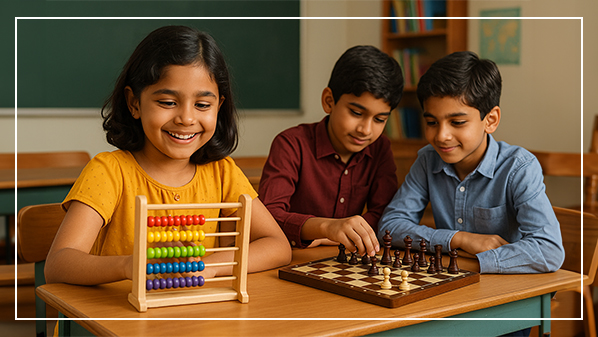
Gamification has taken the center stage in recent years as a learning technique, particularly in classroom settings that are committed to reaching digital-native students. Gamification, the act of applying game mechanics to non-game environments such as schooling, purports to make learning more fun and interactive. But as international schools with innovation and technology focus increasingly embrace this approach, the question still lingers: does gamification actually enhance learning?
The Science Behind Gamification
Gamification is much more than merely gamifying lessons. It borrows a lot of motivation and psychological principles to drive behaviour and learning. The prime elements of gamification like point systems and level progression tap into the human need to achieve and be recognised. These factors, when inserted strategically into learning activity, can maximise student engagement and focus.
Many studies indicate that gamified learning can enhance student motivation and time on task. For example, students studying through a gamified math platform are likely to spend more time and effort to solve challenging problems in order to access the next level or receive a virtual badge. More time spent on task tends to accompany better understanding and retention. Although its effect might differ based on the way gamification is used, its ability to construct an engaging and adaptive learning space is apparent.
Gamification in Practice
In the classroom, gamification comes in a variety of different forms. Teachers may employ quizzes with leaderboards, virtual escape rooms, or interactive storytelling websites. These formats can especially help students who have difficulty in the standard classroom environment by giving them other means of proving knowledge and gaining confidence.
International schools with innovation and technology focus are particularly placed to adopt gamification. With access to some of the best digital tools and platforms, such schools can create learning experiences that are immersive and personalised. Let’s say for instance, employing virtual reality for simulations of historical periods or coding games to impart computer science ideas engages the students and also enhances their knowledge through experiential learning.
Notably, successful gamification relies on well-defined educational outcomes. Adding game elements without pedagogical underpinnings can result in distraction rather than increased learning. Successful implementations balance fun with rigour and ensure that the game mechanics reinforce, but do not substitute, substantial learning objectives.
Is Gamification the Future of Learning?
As educational requirements change, gamification provides a powerful solution to the issues of student motivation and individualised learning. It is well in line with the thrusts of top international schools in West Bengal with holistic education, which are always looking for means to make learning more relevant and effective for an international student population.
However, it is important to note that gamification is not a panacea. It is meant to supplement, not substitute for, good teaching practices. Teachers must be given professional development to know how to incorporate gamification meaningfully, and the schools should evaluate its effect continuously. Also, teachers should be aware of students who are not likely to react favourably to competitive activities and provide differentiated experiences to accommodate different learning preferences.
When applied with careful consideration, gamification has the potential to turn the classroom environment into one where students are engaged active participants in their own education. Gamification promotes persistence and curiosity which are the abilities that are essential within and outside of school.
To put it in perspective, gamification is not here today and gone tomorrow but is a weapon that can redefine education if handled carefully. This transformation is being initiated by best international school in kolkata areas of study and setting the pace for others to follow suit. As we venture into new means of motivating and educating, gamification is an interesting strategy that, if backed by good pedagogy, actually delivers.
Additional Reading:
- Why Personalised Education Is the New-Gen Method of Learning?
- Shaping Physical Health with International Schools with Sports Facilities in Kolkata