
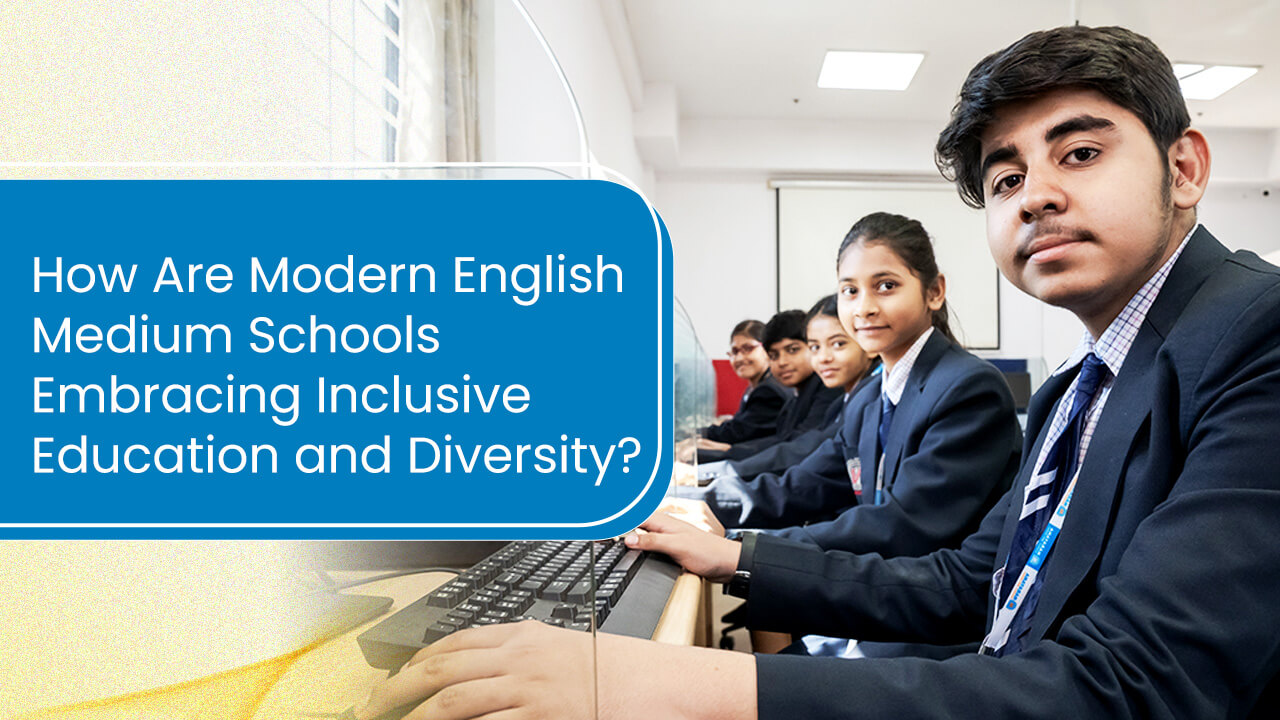
Education these days is not simply about textbooks and tests. It is about enabling each child to grow with self-belief, compassion and equal opportunities. Contemporary English medium schools are transforming their method of teaching. They are embracing children from all walks of life. They are providing equal dignity to each child. And they are making classrooms a safe and cheerful place for all.
Parents these days demand schools that are concerned with something beyond marks. They desire schools that deal with values, diversity, and equality. These are the reasons why many families are looking for an English-medium school. They see these as meeting the requirements of the future for their children. What sets these modern institutions apart is inclusive education and diversity. Let us explore why these are so crucial for your child’s future.
What are Inclusive Education and Diversity?
Inclusive education is when all children learn together in one classroom. This consists of children with varying abilities, languages, cultures or backgrounds. Whether a child is slow or fast in studies, poor or rich, shy or outspoken, the school welcomes all and helps them.
Diversity implies differences. It may be cultural, social or physical. In a school, diversity is observed when children belonging to different religions, communities or types of families learn together. You observe it when schools accept children with learning disabilities or disabilities alongside other scholars.
The best CBSE school is one that integrates inclusivity and diversity, ensuring all the children feel important. No one feels excluded, and each child has an opportunity to shine.
Why Are Inclusive Education and Diversity Important?
Inclusive education and diversity are important due to the following reasons:
- Fosters Kindness and Respect: When children study alongside people who are not like them, they learn respect and kindness. They begin to realise that all human beings are equal, irrespective of perceived differences.
- Prepares for the Real World: Your child will encounter individuals from different walks of life in the real world. Inclusive schools prepare children for such realities, developing open minds and teaching them to collaborate with anyone.
- Improved Academic Development: Studies indicate that children perform better when they study in inclusive classrooms. Teachers employ techniques that value all kinds of learners. Slow learners get help, and fast learners remain involved as well.
- Boosts Confidence: Inclusive schools make each child feel special. A child who may feel overlooked elsewhere receives complete support here. This instils confidence and self-belief.
- Promotes Equality: Inclusive education combats discrimination and bias. It ensures that no child is discriminated against on the grounds of background, ability, or community.
As per UNESCO, approximately 75% of children with disabilities in India remain out of school. Inclusive schools are striving to transform this deplorable situation by opening doors for all children.
How Modern English Medium Schools are Promoting Inclusive Education
Inclusive education isn’t just a policy at a modern English medium school. It’s more like the soft rhythm of a caring heart. Imagine going into a classroom where each child is seen, safe and celebrated. And here is how institutions are achieving these goals:
Teacher Training with Heart
Teachers don’t merely know their subjects. They know the hearts of their students. Schools provide training beyond the pages of a textbook. Teachers learn to identify the quiet kid who’s having trouble with reading. They also identify the one who’s shy and full of ideas but needs some motivation. They learn the little things to do to help, such as providing more time, utilising visual aids, or drawing out a story on the board. A teacher’s compassion is a child’s springboard for learning.
Technology That Hugs the Learner
Smart boards, tablets and audio-visual equipment aren’t merely fancy gadgets. They respond as friendly mentors. A hearing-impaired child sits through a lesson with captions on smart screens. Another child lacking in the ability to focus learns through interactive apps and reading aloud. Each child has a means of comprehension through touch, vision or hearing. Imagine the smile on a child’s face when a lesson suddenly makes sense, thanks to that helpful animation!
Special Educators with Gentle Hands
For students who require extra help, special educators intervene—not to criticise, but to hold their hand and steer them ahead. They construct small steps, celebrate small victories and ensure no child is ever behind. A struggling math student might learn through hands-on puzzle pieces. A reading-challenged child might enjoy one-on-one storytelling. These teaching moments sow seeds of confidence that come to flower as hardy, persistent learners.
Language Made Easy
Most houses in India speak their native languages. When they step into English medium classes, children require a small bridge. New schools create this bridge with gentle English support. There are extra classes, simplified language apps, and small chat circles. In no time, those initial shy words become confident English sentences.
Celebrating Every Child’s Culture
In such classrooms, celebrations are genuine. Durga Puja, Eid and Christmas all become festive school functions. A child may volunteer her mother’s sweet pastry recipe. Another presents his father’s prayer song. Every festival is a lesson in respect and happiness. Children laugh in company, taste sweets in company and learn that every culture is lovely. This collective warmth spins a classroom family where each child feels at home.
Peer Support That Builds Trust
Here’s a sweet thing: when schools encourage students to help each other. A confident classmate might help a friend who is struggling with homework. The one who is helping feels happy, and the helped feels valued. Friendships grow from trust. This culture teaches children to lift others rather than stand above them. They are planting seeds of cooperation and caring that will stay with them forever.
Flexible Caring Practices
Every child learns uniquely. Some excel with project work. Others bloom with images or reading in silence. Modern schools accept this with adaptable teaching. They combine group projects, visual games and stories. They wait and wait patiently for each child to catch up, applauding every little success. A classroom is a garden where every child blooms at their own pace.
Equality and Diversity in Schools: A Closer Look
Equality and diversity in schools are not hollow words. In good English medium schools, they sound more like the warmth of humming all around. Every child feels a sense of belongingness.
Equal Chances for All
Here, girls play football, boys dance and all children get a turn to lead, sing or speak. A shy child gets to read in the morning assembly. Another gets to conduct the school choir. Equality is when every child’s dream gets a platform, not only the extroverted ones. It says, “You matter. Your talent matters.”
Making Space for All Abilities
When a child is in a wheelchair, the school opens up ramps and accessible bathrooms. They do it even if it takes time to retrofit. When another child requires quiet space due to sensory requirements, a warm corner awaits them. The message here is simple and powerful: “You belong. We made space for you.” This type of care says to a child, “We value you just the way you are.”
Defeating Bullying with Belonging
Classrooms can be challenging. But in diverse, inclusive schools, bullying has no room. Kids understand they’re supposed to support each other, not finger-point. Teachers intervene softly. Their aim is not to scold but to help. They remind students to stop, talk, and listen. No one can hear phrases like “stupid” or “ugly”. They teach kindness, forgiveness and the strength of a kind word.
Learning from Differences
A Tamil boy describes how his family celebrates Pongal. A Marwari boy explains about celebrating Diwali festivities. A Bengali girl narrates the way she decorates clay pots during Durga Puja. These anecdotes are lessons for all children to learn that “different” is not “less”. Each person’s tradition is added to the classroom narrative. This is what makes children realise that diversity is our strength, not our divide.
Equal Learning for Every Ability
Here, students with dyslexia, ADHD, or autism get the attention they deserve. Special instructors modify lessons. Peers learn together with support and understanding. These classrooms echo with a quiet power. All children can learn in their own way. Every mind has worth.
Leadership That Reflects Differences
Children observe leaders ahead of them who embody diversity. They see a teacher wearing a sari and another in a salwar kameez. Students belonging to various communities are members of school councils or groups. Children understand that leadership is not confined to one type of face. It’s accessible to everyone. This sows the seed of thinking that they, too, can lead, regardless of who they are.
Why Parents Are Seeking Inclusive Schools
More and more parents are now understanding that there is more to education than just high marks. They wish to have schools where kids pick up values for life, empathy and respect. Many are looking online for “CBSE schools near me” or “English medium schools nearby” with inclusive practices.
These schools help children adapt to a rapidly changing world. As job markets and society become increasingly globalised, inclusivity and cross-cultural understanding are future skills. These schools also support and aim to help differently-abled children, preparing them for the world outside.
Why Narayana School for Inclusive Education and Diversity?
At Narayana School, we are convinced that each child is distinct. We greet children of all abilities and backgrounds with the same warmth. To us, inclusion is not merely a practice. It is a commitment.
We employ trained teachers who simplify and make learning a delightful experience for all children. Our classrooms are equipped with the latest technology that caters to children of varying learning styles. We honour cultural diversity in classrooms with dignity so that all festivals appear like family celebrations.
We also provide safety and care in every nook and corner of our school. From sports to art, from studies to life skills, every child has the opportunity to explore and excel. Parents label us as one of the best CBSE schools because we strike a balance between academic excellence and diversity.
We desire that every parent should feel that their child is given importance, regarded and cared for here. When you pick Narayana School, you pick a school where no child is left behind.
Conclusion
Inclusive education and diversity in modern schools are no longer a choice. They are the core of schooling today. A contemporary English-medium school that honours differences equips your child with the tools for success in life. It instils empathy, equality and confidence in them. As a parent, your decision today will determine your child’s tomorrow. Seeking a school that balances quality learning with inclusivity? Narayana School is here for you. Provide your child with the gift of inclusive education. Visit us at Narayana School today and start a brighter future for your child.